
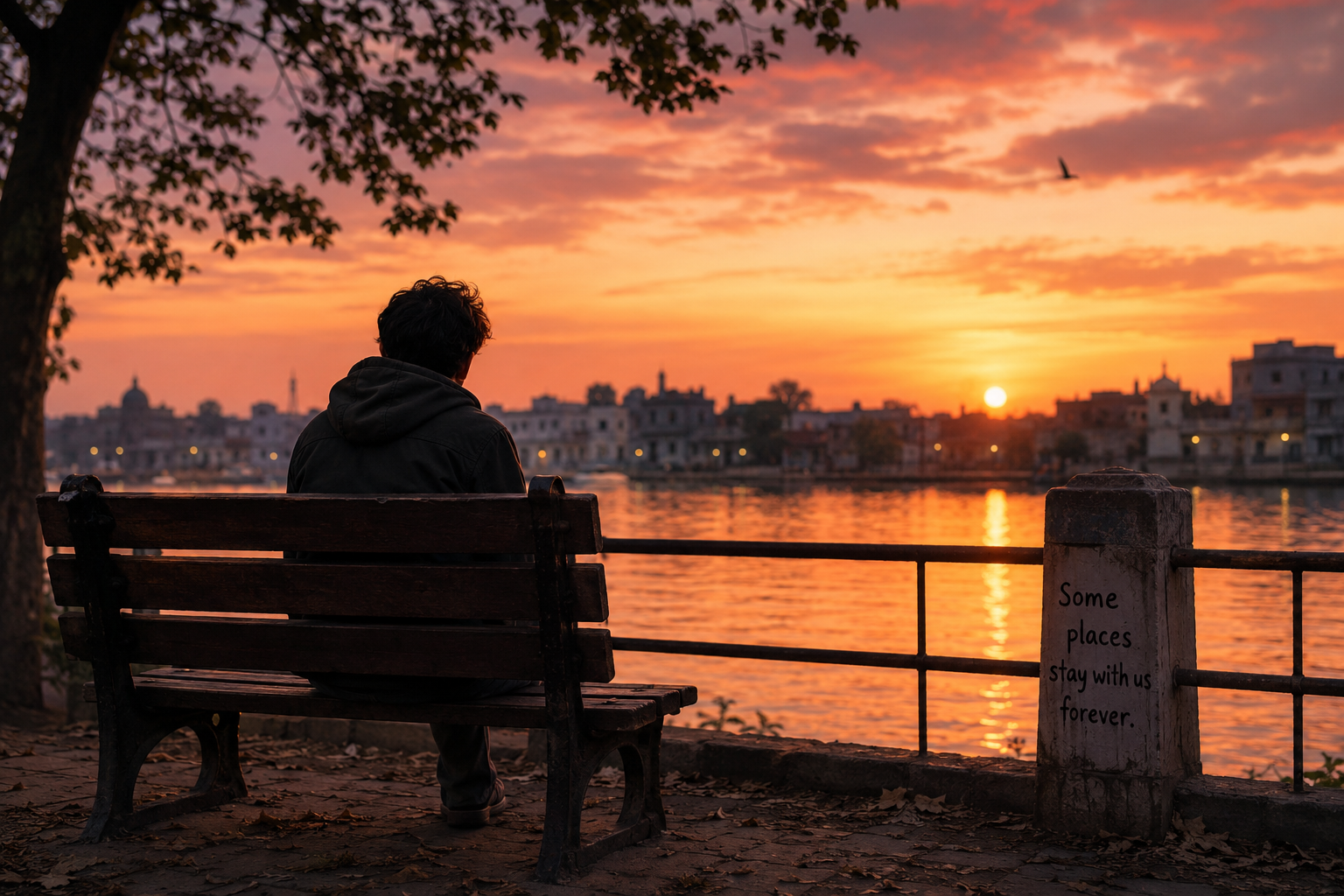
There are places we leave physically but never really leave emotionally.
A small roadside tea stall from college days. A rented apartment with peeling paint. A grandmother’s courtyard that no longer exists. A railway station where someone hugged us goodbye years ago. Sometimes the attachment doesn’t even make logical sense. The place itself may be ordinary. Forgettable, even. But somehow it keeps returning in fragments.
A smell. A season. The sound of distant traffic at night.
And suddenly we are there again.
I used to think emotional attachment to places only happened with childhood homes or hometowns. But growing older changes that idea. You realize humans quietly leave pieces of themselves everywhere. Certain streets absorb versions of us that no longer exist. Some buildings hold our loneliness better than people did. Some corners witnessed who we were before life rearranged everything.
That is probably why certain places continue living inside us long after we stop visiting them.
Not because the places are magical. Mostly because we were.
Places Remember Us Differently Than People Do
People tend to update their opinions about us.
They move on. They reinterpret memories. Sometimes they forget entire chapters. But places don’t do that. A place remains almost stubbornly still in our minds. It keeps preserving a particular version of us.
When I think about the small town where I studied during my late teens, I don’t just remember the roads or shops. I remember the person I was there. Restless. Hopeful. Slightly lost. Certain songs belonged to those evenings. Certain worries felt enormous then.
If I visited today, the town itself would probably look smaller than I remember. That always happens. But emotionally, it still carries the weight it had back then.
And maybe that is what we really become attached to.
Not the place itself, but the emotional atmosphere we once lived inside there.
A person can forget your favorite tea order. But an old café still remembers the exact window where you sat after difficult days. At least in your memory, it does.
That feeling is strangely comforting.
Some Places Hold Versions of Ourselves We Miss
There are cities where we felt brave for the first time.
Rooms where we cried without anybody noticing. Bus stops where life quietly changed direction. Places where we were deeply happy before we even understood happiness properly.
Years later, we return expecting nostalgia, but what hits us instead is grief for an older self.
I once revisited a neighborhood I had not seen in almost eight years. Nothing dramatic happened there originally. No life-changing romance. No movie-like memory. I had simply lived there during a period when life felt open-ended and unfinished in a good way.
Walking through those streets again felt unsettling.
The bakery was still there. The pharmacy too. Even the stray dogs somehow looked familiar. But the strange part was realizing that the younger version of myself who once walked there every evening no longer existed.
That realization stays with you.
Sometimes emotional attachment to places is really attachment to abandoned versions of ourselves.
And honestly, I think that is why revisiting certain places can feel heavier than meeting old friends.
Ordinary Places Often Become the Most Meaningful
It is rarely the famous landmarks that stay with us forever.
Usually it is something embarrassingly ordinary.
A staircase in an old apartment building. A narrow grocery shop where the owner knew your family. The terrace where electricity cuts forced everyone outside during summer nights. A college corridor with cracked walls and bad lighting.
Real emotional memory attaches itself to repetition.
We remember places where daily life happened. Where routines unfolded quietly. Human beings become emotionally connected through familiarity more than spectacle.
Tourist places impress us.
Ordinary places absorb us.
That difference matters.
I think about this whenever people say, “It was just a small town,” or “It was just a rented house.” There is no such thing as “just” a place once enough life has happened inside it.
A kitchen where your mother cooked every morning is not just a kitchen anymore. A roadside bench where friends gathered every evening stops being furniture. These places become containers for emotional residue.
Even years later, they continue carrying emotional weight we cannot fully explain.
Smell and Sound Keep Places Alive
Memory is strange because it is rarely visual first.
Sometimes a smell can reopen an entire world before you consciously recognize it.
Wet soil after the first rain. Old books. Hospital corridors. Chalk dust in classrooms. Coconut oil in someone’s hair. Railway stations at dawn.
These things travel directly into memory without asking permission.
The same happens with sound.
Ceiling fans in old houses. Pressure cookers from neighboring kitchens. Temple bells in the distance. Evening cricket commentary from someone else’s television. The hum of traffic through half-open windows.
Years pass, yet one familiar sound can suddenly bring back an entire location with uncomfortable clarity.
And for a few seconds, time collapses.
You are not remembering anymore. You are briefly living there again.
That experience feels almost physical sometimes.
It is also why people become emotional over places others find completely unremarkable. Outsiders only see the structure. The person attached to it sees accumulated life.
Leaving a Place Does Not Always Mean We Are Ready To Leave It
Life moves people constantly now.
Jobs change. Rent increases. Families relocate. Relationships end. Entire neighborhoods disappear under new construction. Leaving has become normal.
But emotional timing does not always match physical movement.
A person can leave a city years before emotionally processing what that city meant to them.
I think many adults quietly carry unfinished relationships with places.
That old hostel room. The town where they first lived alone. The city where they failed at something important. The home they outgrew but still dream about occasionally.
Some people keep revisiting places online through street view maps late at night. Others replay memories during long drives. Some avoid returning completely because they know the emotional impact would be too much.
It sounds dramatic when written down like this, but honestly, it is incredibly common.
Humans are deeply environmental creatures. Places shape our emotional lives more than we admit.
The café where someone listened to us during a difficult year becomes emotionally sacred. Not because of the furniture or coffee quality, but because of what happened there internally.
Sometimes We Mourn Places Like People
This part feels difficult to explain unless you have experienced it.
But sometimes losing access to a place creates genuine grief.
A childhood home gets sold. A favorite bookstore closes. An old neighborhood changes completely. A cinema hall becomes a shopping complex. A school playground disappears behind apartment buildings.
People often dismiss this kind of sadness because technically nothing “serious” happened.
But emotionally, something did happen.
A physical anchor connected to memory disappeared.
And with it, a small piece of personal continuity vanishes too.
I remember hearing someone say they avoided driving through their old street after redevelopment because “it feels like somebody erased evidence that my life happened there.”
That sentence stayed with me.
Because memory already fades naturally over time. Places help stabilize it. When those places disappear, memories suddenly feel less solid too.
Maybe that is why we photograph ordinary places before leaving them. Empty rooms. Bus windows. Street corners. Parking lots.
Not because the locations are beautiful.
Because we are afraid of forgetting who we were there.
We Keep Searching for Familiar Feelings in New Places
One interesting thing about growing older is realizing we spend years trying to recreate emotional atmospheres from earlier places.
People search for cafés that feel like the one they loved in college. Apartments with similar balconies. Cities with the same pace. Neighborhoods that somehow resemble home.
Not exactly in appearance. More in feeling.
Sometimes we even arrange furniture similarly without noticing.
I do not think this is laziness or inability to move on. It is human behavior. We are constantly searching for environments where we can emotionally recognize ourselves.
And every now and then, a new place unexpectedly becomes important too.
Usually slowly.
One morning you realize a local shop owner recognizes you. A road has become part of your routine. The evening light through your current window feels familiar now.
Without noticing, another place begins settling inside you.
That is both comforting and sad somehow.
Because it reminds us attachment never really stops happening.
Conclusion
Some places continue living inside us because they witnessed unguarded versions of our lives.
They saw us before certain disappointments. Before responsibilities hardened us a little. Before people left. Before we learned how temporary almost everything is.
And even when the buildings change or the roads become unrecognizable, the emotional imprint remains strangely intact.
Years later, we still carry those places quietly.
In habits. In dreams. In sudden moments of homesickness we cannot fully explain.
Maybe emotional attachment to places is really about wanting proof that our experiences mattered somewhere physically. That our laughter, loneliness, confusion, love, and ordinary routines did not disappear completely.
So certain places stay alive inside us.
Not because we refuse to move forward.
But because parts of our life are still sitting there patiently, waiting on an old staircase, under a dim streetlight, beside a familiar window we may never see again.
FAQs
Why do people develop emotional attachment to places?
People form emotional attachment to places because important experiences happen there. Memories connected to relationships, routines, personal growth, or difficult moments become associated with physical environments over time.
Why do old places feel emotional when revisited?
Revisiting old places often brings back memories of earlier versions of ourselves. The emotional reaction is usually tied to nostalgia, personal change, and the realization that certain periods of life are gone.
Can ordinary places become emotionally meaningful?
Yes. Emotional connection usually develops through repeated daily experiences, not through impressive locations. Simple places like cafés, classrooms, streets, or rented homes often become deeply meaningful because life happened there consistently.
0 Comments