
Introduction
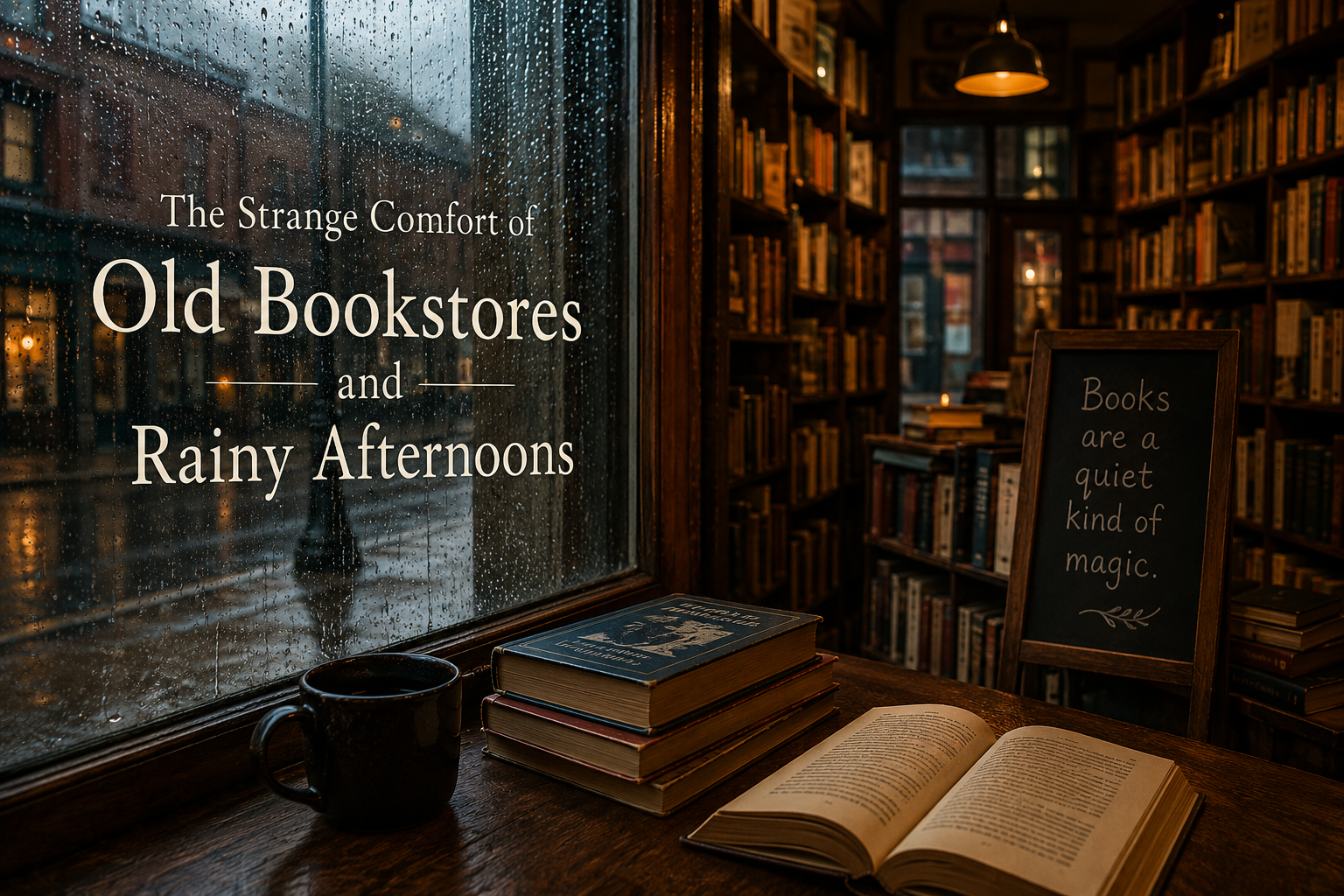
There’s something oddly calming about stepping into an old bookstore while it’s raining outside.
Not the shiny modern kind with bright lights and shelves arranged like a supermarket. I mean the slightly cramped ones. The places where the wooden shelves lean a little, where the owner looks up slowly from behind a newspaper, and where the air smells faintly of dust, paper, and time.
You don’t even have to buy anything.
Sometimes just being there feels enough.
Rain changes the mood of a city in strange ways. Roads slow down. People stop rushing for a while. Even noisy places soften around the edges. And inside an old bookstore, that feeling becomes stronger. The outside world keeps moving, but more quietly now, like someone turned the volume down.
Maybe that’s part of the comfort in bookstores. They let you disappear without feeling lonely.
Not invisible exactly. Just… temporarily removed from the pressure of being somewhere else.
The Kind of Silence That Feels Friendly
Libraries have silence too, but bookstores feel different.
Libraries often carry a sense of responsibility. Return dates. Rules. Whispering. But old bookstores feel looser somehow. You can wander without purpose. Pick up a book you never planned to read. Stand in one corner for fifteen minutes reading the first page of something from 1987.
Nobody bothers you.
The silence inside these places isn’t strict. It’s soft.
You hear small things instead. The sound of pages turning somewhere behind you. A ceiling fan clicking every few seconds. Rainwater dripping near the entrance. Occasionally someone coughing in another aisle.
Tiny human sounds.
And maybe that’s why the atmosphere feels comforting. Nothing dramatic is happening there. Nobody is trying to impress you. There’s no urgency in the room.
You exist quietly among strangers who also came looking for something they probably can’t fully explain.
Old Bookstores Feel Untouched by Performance
A lot of places today feel designed to be photographed first and experienced later.
Cafés with neon signs. Restaurants where the lighting exists mainly for Instagram pictures. Even some bookstores now feel more like lifestyle stores than actual places for readers.
But old bookstores usually escape that.
They aren’t curated carefully enough to feel artificial. The shelves are overcrowded. Half the books are misplaced. Sometimes there’s a random engineering textbook sitting between poetry collections for no clear reason.
And honestly, that disorder makes the place feel human.
You can tell these stores evolved slowly over years instead of being designed all at once by a branding consultant.
There’s comfort in spaces that weren’t built to perform.
A person browsing an old bookstore doesn’t need to look interesting while doing it. Nobody cares how fashionable you are. Nobody asks what you do for work. You’re just another person standing near a stack of books with rainwater drying on your sleeves.
That simplicity feels rare now.
Rain Somehow Makes Everything More Honest
On sunny days, people move differently. Faster. More distracted.
Rain slows people into themselves.
Maybe that’s why rainy afternoons and bookstores fit together so naturally. Both create a kind of pause. Not a dramatic life-changing pause. Just a temporary lowering of noise.
You notice things more carefully in that mood.
The handwritten price inside an old paperback. The faded cover art on novels nobody talks about anymore. A bookmark left behind by someone years ago.
Sometimes you open a used book and find a sentence underlined by a stranger. That tiny discovery can feel strangely intimate.
You start imagining the previous owner. Who they were. Why that line mattered enough to mark.
It’s funny how old bookstores quietly remind us that people have always been trying to understand themselves through words.
Not just now. Always.
The Comfort Has Very Little to Do With Buying Books
People assume book lovers go to bookstores because they constantly want new books.
Honestly, not always.
Sometimes people go because bookstores feel emotionally safe.
That sounds overly dramatic when phrased directly, but it’s true.
There are days when you don’t want entertainment or productivity or conversation. You just want somewhere to exist for an hour without feeling pushed. Old bookstores offer that in a way few public places still do.
You can walk slowly. Touch things carefully. Read random pages. Sit in a corner if the owner allows it.
Nobody expects efficiency from you there.
And maybe that matters more than we admit.
Modern life measures everything through usefulness. What did you achieve today? What did you finish? What are you building toward?
Inside an old bookstore during rain, those questions lose some of their grip for a little while.
You’re allowed to simply browse.
That word itself feels gentle. Browse. No pressure attached to it.
Some Memories Attach Themselves to Places
A lot of people have a bookstore memory somewhere in their life.
Maybe it was a small shop near their college. A secondhand store they visited after work. A roadside bookstore during a trip they barely remember otherwise.
The memory usually isn’t about the exact book they bought.
It’s about the feeling around it.
The weather that day. The song playing faintly somewhere. The awkward conversation with the shop owner. The relief of escaping heavy traffic outside.
Certain places absorb emotions quietly over time.
You return years later and suddenly remember versions of yourself you had forgotten.
The anxious student.
The lonely twenty-three-year-old.
The person who once believed moving to another city would solve everything.
Old bookstores hold those versions gently without forcing you to confront them too hard.
That may be another reason the comfort in bookstores feels so personal. These places become emotional landmarks without us realizing it.
There’s Something Reassuring About Old Pages
New books smell clean and sharp. Old books smell lived-in.
It’s difficult to explain why that matters, but it does.
A worn book carries evidence of previous lives. Folded corners. Yellowing pages. Cracks along the spine. Sometimes notes in the margins written in hurried pen strokes.
You’re reminded that stories survive people.
That thought can feel strangely calming on difficult days.
Not in some grand philosophical way. Just quietly comforting.
A person decades ago sat somewhere reading the same pages you’re holding now. Maybe during their own rainy afternoon. Maybe while waiting for something in life to improve.
And now the book continues traveling through different hands.
There’s continuity in that.
In a world obsessed with constant newness, old bookstores gently resist the idea that everything valuable must also be recent.
The Owners Often Become Part of the Atmosphere
Old bookstore owners tend to have a very specific energy.
Some are talkative. Others barely speak. A few look permanently irritated until you ask about a book they love, and suddenly they transform into entirely different people.
They remember impossible details too.
A customer who came six months ago looking for Russian literature. A book that was sold years earlier. The exact shelf where a certain author used to sit before the store was rearranged.
You get the feeling that these people aren’t running the shop to become wealthy.
Most probably know the business isn’t practical anymore.
But they stay.
Maybe because they also need the space.
That realization changes how you see the store itself. It becomes less of a business and more of a slowly maintained refuge for people who still find comfort in paper, silence, and unhurried afternoons.
Not Everything Needs to Be Efficient to Matter
Old bookstores waste time beautifully.
You can spend forty minutes there and leave with nothing except a calmer mind.
Modern culture often treats that as failure. If no purchase happened and no measurable progress was made, what was the point?
But human beings probably need useless wandering more than we admit.
Not every meaningful experience has to produce something.
Sometimes a rainy afternoon spent browsing forgotten books is enough on its own.
No transformation required.
No deep lesson waiting at the end.
Just a quieter nervous system. A slightly lighter mood. Maybe a sentence from a novel that stays in your head during the ride home.
That’s already valuable.
Conclusion
The comfort in bookstores isn’t really about nostalgia, even though nostalgia plays a role.
It’s about relief.
Relief from noise. From performance. From speed. From constantly needing to optimize every hour of the day.
Old bookstores ask almost nothing from you. You enter, wander, think a little, maybe remember a few things about your life, then leave when the rain slows down.
That’s all.
And somehow, that small experience continues to matter.
Maybe because places like that are becoming rare.
Or maybe because people are still quietly searching for spaces where they can feel human without trying too hard.
An old bookstore on a rainy afternoon offers exactly that. Nothing magical. Nothing life-changing.
Just a brief, believable kind of peace.
FAQs
Why do old bookstores feel comforting?
Old bookstores often feel calming because they are quiet, slow-paced, and free from pressure. The atmosphere, smell of books, and relaxed browsing experience create a sense of emotional comfort and escape.
Why do people enjoy bookstores during rainy weather?
Rain naturally slows people down and creates a reflective mood. Combined with the peaceful environment of a bookstore, it can feel cozy, calming, and emotionally grounding.
What makes secondhand bookstores different from modern bookstores?
Secondhand bookstores usually feel less commercial and more personal. They often contain older books, unique discoveries, and a lived-in atmosphere that feels more human and less curated.
0 Comments