
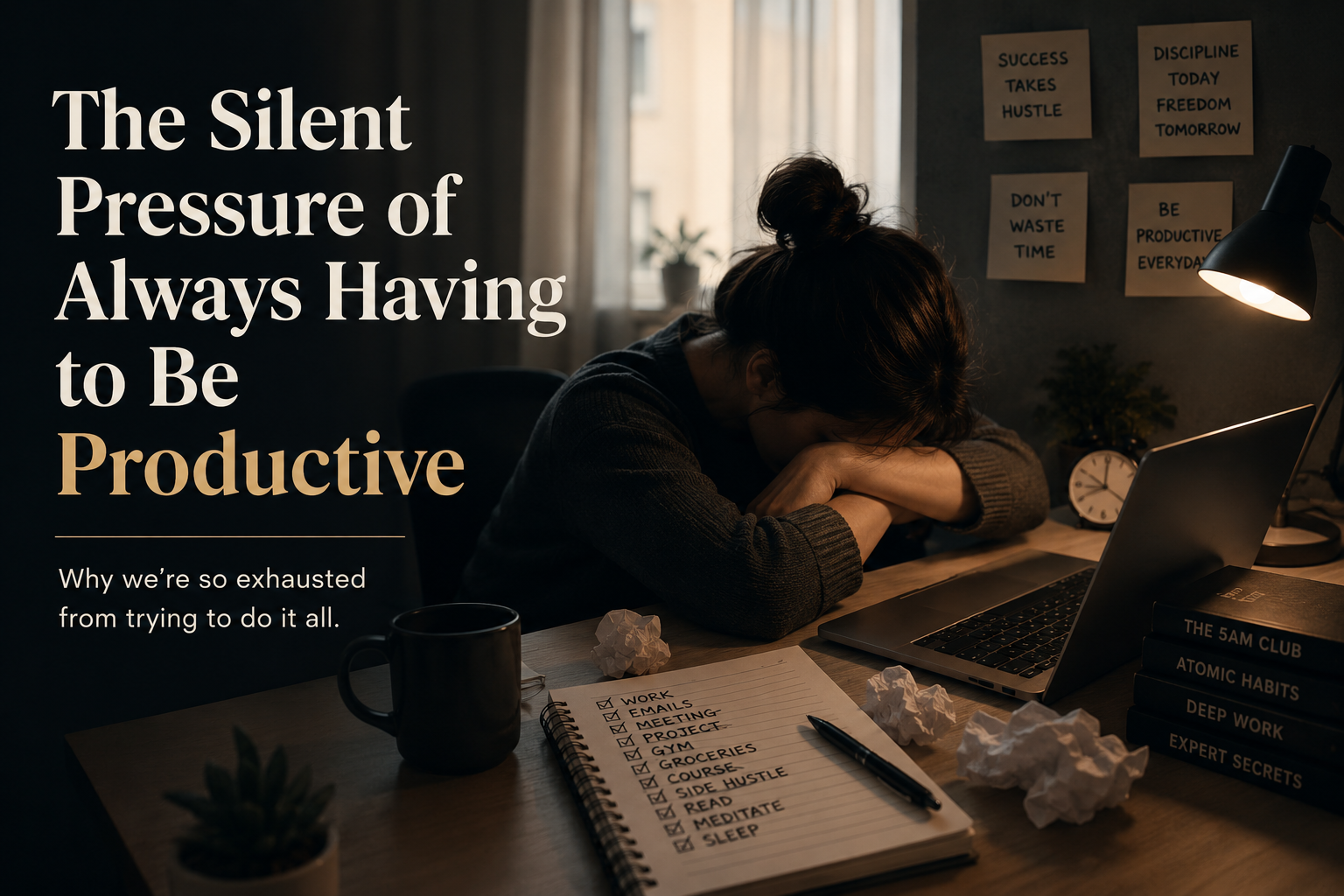
There’s a strange kind of guilt that appears when you sit still for too long.
Not dramatic guilt. Not the kind tied to hurting someone or making a serious mistake. Something quieter than that. A low hum in the background.
You finish work and immediately think about what else you should be doing. You open your phone for five minutes and somehow feel irresponsible afterward. Even rest starts to feel like a task you need to justify.
A lot of people carry this feeling now without fully noticing it. The pressure to constantly improve, create, optimize, monetize, organize, learn, and achieve has blended into ordinary life so smoothly that it barely looks unhealthy anymore.
That’s part of what makes toxic productivity difficult to recognize.
It rarely arrives as obvious burnout in the beginning. Sometimes it looks responsible. Ambitious. Disciplined. Even admirable.
Until one day you realize you don’t actually remember how to relax without feeling slightly anxious.
When Rest Starts Feeling “Earned”
One of the oddest shifts in modern adult life is how rest slowly became conditional.
People talk about relaxing the same way they talk about rewards.
“I’ve earned a break.”
“I’ll rest after this week.”
“I can relax once I finish everything.”
But the list rarely finishes.
There’s always another email. Another goal. Another skill you should probably learn before everyone else does. Another habit you need to build. Another thing you forgot to reply to three days ago.
Even hobbies started changing shape. Reading became “reading goals.” Walking became “step counts.” Journaling became self-optimization. Sleep became productivity fuel instead of basic human care.
Somewhere along the way, simply existing stopped feeling sufficient.
You can see it in tiny everyday moments.
People watching Netflix while answering Slack messages.
Checking emails at dinner.
Feeling restless on a Sunday afternoon because the day wasn’t “useful enough.”
Opening social media and immediately seeing someone announcing a promotion, launching a business, posting workout progress, or waking up at 5 a.m. to “stay ahead.”
After enough exposure, stillness starts to feel suspicious.
The Internet Turned Human Beings Into Ongoing Projects
Part of this pressure comes from the fact that modern life constantly presents improvement as a moral responsibility.
There’s always another version of yourself waiting to be unlocked.
A fitter version. Smarter version. Wealthier version. More disciplined version. More attractive version. More efficient version.
The language around self-growth used to feel softer. Personal. Reflective.
Now it often sounds like performance management.
You’re encouraged to “maximize your mornings,” “eliminate wasted time,” “build six income streams,” and “stay consistent no matter what.”
And honestly, some of that advice can help in moderation. Structure matters. Ambition matters too.
But toxic productivity starts when your entire self-worth quietly merges with output.
That’s the dangerous part.
Because once that happens, resting no longer feels neutral. It feels like failure.
You start measuring your days like machines measure efficiency.
Was today useful enough?
Did I waste time?
Did I fall behind?
Am I doing enough compared to everyone else?
It becomes exhausting in a very specific way. Not just physical tiredness. Emotional tiredness. Mental overcrowding.
Even peaceful moments become interrupted by invisible evaluation.
The Performance of Being Busy
There’s also a social element to all this that people don’t talk about enough.
Being busy has become a status symbol.
When someone asks how you’re doing, saying “busy” almost sounds respectable now. Important, even.
Meanwhile, calmness can strangely appear lazy to people.
A person working nonstop is praised for dedication.
A person protecting their free time is often treated like they lack ambition.
That pressure builds slowly in workplaces, friend groups, creative industries, and even families.
You notice people apologizing for resting before anyone accused them of anything.
“I know I should be doing more.”
“I’ve been unproductive lately.”
“I wasted the whole weekend.”
Sometimes the “waste” they’re talking about is sleeping properly, seeing friends, cooking slowly, or sitting outside for an hour.
Normal human experiences now compete with optimization culture.
And there’s another uncomfortable reality underneath it all: many people genuinely can’t afford to slow down financially. Rising costs, unstable work, and constant economic anxiety make productivity feel tied to survival.
That matters.
Not all exhaustion comes from mindset alone. Some of it comes from systems that reward overwork and punish vulnerability.
Still, even people who technically have time off often struggle to mentally leave work behind. The pressure follows them home.
Sometimes it even follows them into bed.
The Strange Loneliness of Constant Productivity
People often imagine productivity as empowering. And sometimes it is.
Finishing meaningful work feels good. Creating something satisfying feels good. Progress matters.
But constant productivity can become oddly isolating too.
When every hour needs purpose, relationships start becoming secondary. Conversations feel interrupted by mental to-do lists. Leisure starts carrying guilt attached to it.
You sit with friends but part of your brain whispers that you should be answering emails.
You watch a movie but feel slightly tense the whole time.
You take a break and somehow spend the break thinking about work.
A lot of people are physically resting while mentally remaining “on.”
That’s why burnout is complicated. It isn’t always dramatic collapse. Sometimes it’s a slow emotional flattening.
You still function.
You still show up.
You still complete tasks.
But joy becomes thinner around the edges.
Life starts feeling like maintenance instead of experience.
And weirdly, some people become so accustomed to this state that slowing down feels uncomfortable at first. Silence becomes unfamiliar. Free time feels almost intimidating.
That alone says something important.
Social Media Made Productivity Feel Public
Years ago, much of people’s effort stayed private.
Now nearly everything can be displayed.
Morning routines.
Workout consistency.
Business milestones.
Study sessions.
Side hustles.
Reading habits.
Income reports.
There’s nothing inherently wrong with sharing achievements. But constant exposure creates psychological pressure whether people admit it or not.
You start comparing your invisible life to other people’s highlight reels.
And because productivity content is usually framed positively, exhaustion often gets hidden behind aesthetic lighting and motivational captions.
People post burnout while still performing productivity through the burnout.
There’s also a strange competitiveness around suffering now.
Who sleeps less.
Who works harder.
Who sacrifices more.
Who’s “grinding.”
The problem is that human beings are not designed to operate at maximum intensity indefinitely. Even machines overheat eventually.
But online culture often treats exhaustion as evidence of commitment.
If you’re tired all the time, maybe you’re trying hard enough.
That idea sinks into people quietly.
Some People Don’t Even Know What They Enjoy Anymore
This might be one of the saddest effects of toxic productivity.
People lose touch with activities that have no measurable outcome.
Not everything meaningful produces visible results.
Some experiences exist purely because they make life feel softer, calmer, or more alive.
Walking without tracking steps.
Drawing badly for fun.
Listening to music without multitasking.
Cooking slowly.
Sitting somewhere without documenting it.
Doing absolutely nothing for a while.
A lot of adults have forgotten how to engage with life outside achievement structures.
And honestly, it’s understandable. Many people were raised to believe usefulness determines value.
Schools reward output early.
Workplaces reward endurance.
Algorithms reward visibility.
Eventually people internalize the idea that they must constantly justify their existence through productivity.
That’s a heavy way to live.
Rest Is Not a Personality Flaw
There’s a difference between avoiding responsibility and being human.
That distinction matters.
Some people hear conversations about burnout and immediately assume it means abandoning ambition altogether. It doesn’t.
Wanting meaningful work is normal.
Wanting progress is normal.
Wanting success is normal too.
The problem begins when productivity becomes your entire identity.
Because identities built only on performance are fragile. The moment you slow down, struggle, fail, or simply need recovery, your sense of self starts collapsing with it.
That’s why so many people panic during periods of rest.
Without constant motion, they’re forced to confront themselves outside achievement.
And that can feel unfamiliar.
Maybe even scary.
But human beings were never meant to function like endless production systems.
You are allowed to have days that don’t become milestones.
You are allowed to enjoy things that lead nowhere.
You are allowed to rest before reaching complete exhaustion.
Not because you “earned” it perfectly.
Because you’re a person.
Conclusion
The pressure to constantly optimize life has become so normal that many people no longer question it. They just carry the anxiety quietly and assume adulthood is supposed to feel this tense all the time.
But toxic productivity slowly shrinks life if left unchecked.
It steals attention from ordinary moments. It turns rest into guilt. It makes people feel permanently behind even when they’re already exhausted.
Ambition itself is not the enemy. Meaningful work matters. Discipline matters too.
But a life where every moment must prove its usefulness eventually becomes emotionally narrow.
Some of the healthiest moments people experience are the ones that produce nothing measurable at all.
A slow evening.
An unproductive conversation.
A quiet walk.
A nap without guilt.
A day that exists simply because you needed it.
That kind of life may not look impressive online.
But it often feels far more real.
FAQs
What is toxic productivity?
Toxic productivity is the unhealthy pressure to constantly work, improve, or achieve something at all times. It often creates guilt around rest and ties self-worth too closely to productivity.
How do I know if productivity has become unhealthy?
Signs include feeling guilty while relaxing, struggling to disconnect from work, constantly thinking you’re behind, or feeling anxious during free time even when responsibilities are handled.
Is ambition the same as toxic productivity?
No. Ambition can be healthy and fulfilling. Toxic productivity happens when achievement becomes tied to your identity and you feel unable to rest without shame or anxiety.
0 Comments