
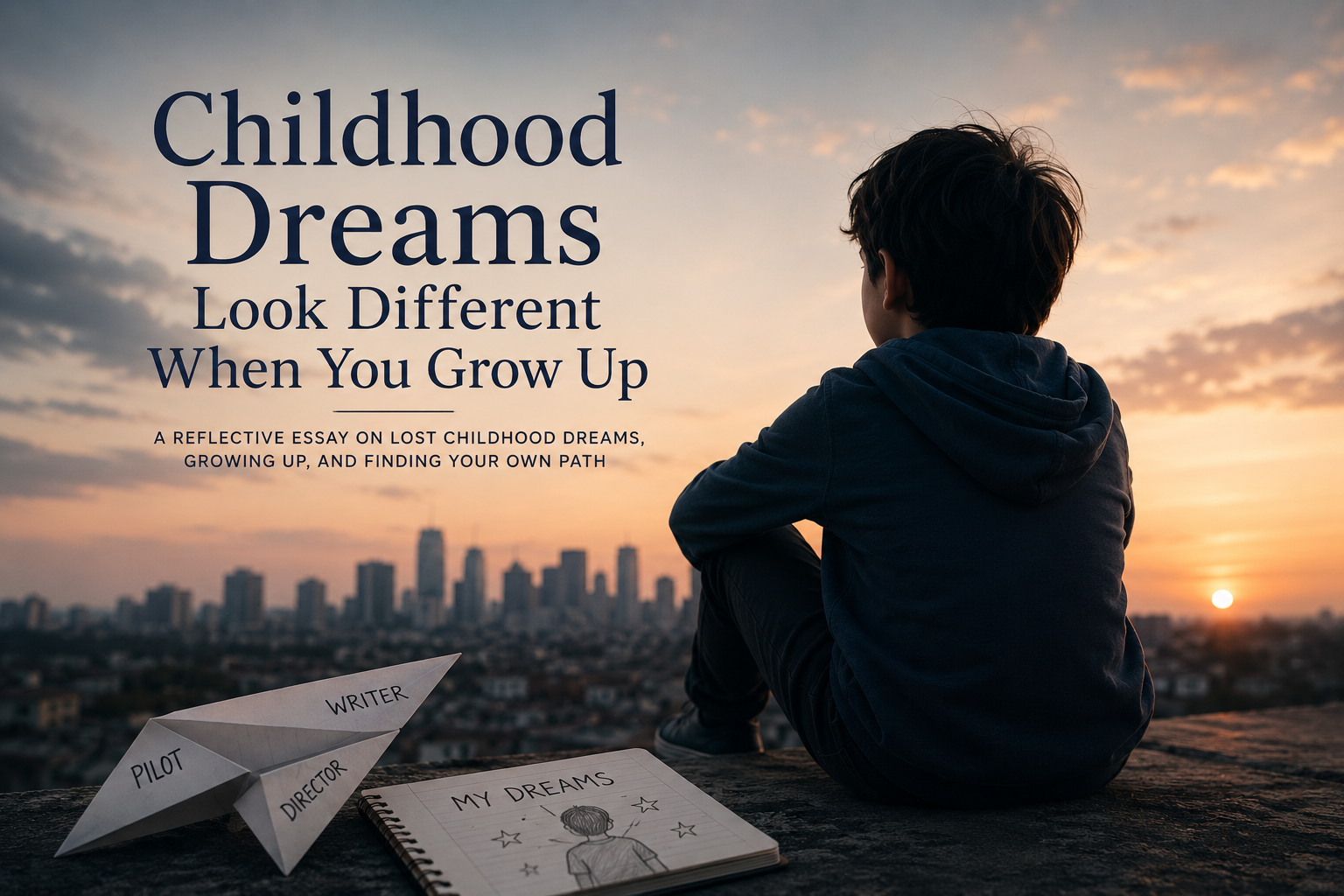
When you are a child, the future feels strangely simple.
You think adulthood is mostly about choosing what you want and becoming it. A singer. A pilot. A writer living near the sea. A cricket player. Someone important. Someone unforgettable.
Children rarely think about rent, exhaustion, family pressure, rejection, or how quickly confidence can disappear after enough disappointments. Dreams feel direct back then. Almost physical. You can point at them.
I remember how casually adults used to ask children what they wanted to become. As if every answer carried certainty.
And children answered with complete seriousness.
Not because they had carefully planned their future, but because they still believed wanting something strongly might be enough.
Growing up changes that belief little by little.
Not all at once. That would almost be easier.
Instead, life slowly edits your imagination without asking permission first.
The Dreams We Once Defended So Seriously
Some childhood dreams disappear naturally. That part is normal.
A ten-year-old wanting to become an astronaut does not always mean failure when they later become a teacher, designer, accountant, or mechanic. People change. Interests change too.
But some dreams do not disappear because we stopped caring.
They disappear because reality became louder.
There is a difference.
A lot of people carry quiet grief about this. Not dramatic grief. Not the kind people openly discuss. Just a small ache that shows up unexpectedly during ordinary moments.
Maybe while driving home from work.
Maybe while seeing someone younger doing the exact thing they once dreamed about.
Maybe while cleaning old shelves and finding school notebooks filled with drawings, plans, signatures, fake company names, or stories they were certain the world would someday read.
That version of ourselves feels innocent now. Slightly embarrassing, maybe. But also honest in a way adulthood sometimes is not.
Children dream without calculating risk first.
Adults rarely do.
Growing Up Introduces Conditions
Nobody explains how many conditions adulthood quietly attaches to ambition.
You can chase your dream, but only if you earn enough.
Only if your family approves.
Only if you survive failure long enough.
Only if your mental health stays stable.
Only if responsibilities do not arrive early.
Only if you do not get tired.
Only if life does not interrupt.
For many people, lost childhood dreams are not about laziness or lack of talent. Sometimes life simply becomes crowded.
A person who once wanted to paint spends most of their energy surviving workdays.
Someone who loved music stops touching instruments because exhaustion replaces curiosity.
Someone who wanted to write novels now writes polite emails all day and cannot look at another blank page afterward.
This happens more often than people admit.
And honestly, adulthood can make practicality feel morally superior. Society praises stability. Predictability. Sacrifice.
Dreams become acceptable only when they succeed financially.
Otherwise they are treated like hobbies you should eventually outgrow.
The Strange Moment You Realize Your Life Looks Different
I think one of the strangest adult experiences is realizing you accidentally became someone your younger self never imagined.
Not necessarily worse. Just different.
Sometimes the realization happens quietly.
You are standing in a grocery store comparing cooking oil prices when it suddenly hits you that younger you imagined adulthood very differently.
As children, we picture dramatic futures.
As adults, life often becomes routines.
Laundry waiting in a corner.
Missed calls from relatives.
Back pain from sitting too long.
Too many browser tabs open.
Thinking about savings accounts while reheating leftover rice.
There is something oddly humbling about it.
Especially because many adults still feel mentally unfinished inside. People assume growing older creates certainty, but most people are improvising far more than they admit.
That confident adult image we had as children was partly fiction.
Some Dreams Change Shape Instead of Dying
Not every childhood dream disappears completely.
Sometimes it simply survives in smaller forms.
The child who wanted to become an artist still notices colors carefully.
The future filmmaker becomes the person who records beautiful family videos no one else thinks to capture.
The boy who dreamed of becoming a football player coaches local kids on weekends.
The girl who once wanted to become an author keeps journals filled with observations nobody reads but herself.
There is sadness in this, yes. But also something quietly meaningful.
Because maybe dreams are not always about achievement alone.
Maybe part of their purpose was shaping how we see the world.
That matters too.
We tend to measure dreams only by visible success. Career titles. Awards. Recognition.
But some dreams stay alive privately. They soften people. They keep certain parts of them awake.
And honestly, that may be more valuable than we give credit for.
Social Media Makes Old Dreams Feel Closer and Farther Away
Growing up in the internet era adds another layer to all this.
Now people constantly witness others living versions of lives they once imagined for themselves.
Someone your age becomes successful on YouTube.
Another publishes a book.
Someone else moves abroad, opens a café, starts a business, becomes famous online.
You scroll through these updates while sitting in traffic or waiting for your salary to arrive.
It can create a strange emotional confusion.
Part inspiration. Part envy. Part regret.
Not because you hate other people’s success, but because it reminds you of versions of yourself that never fully happened.
And social media rarely shows the complicated middle of life. It mostly displays outcomes.
You do not see the years someone spent failing quietly before things worked out.
You only see the visible result and compare it against your own unfinished life.
That comparison can become exhausting if you are not careful.
Sometimes We Also Romanticize Our Childhood Dreams
Still, adulthood brings one uncomfortable realization people avoid discussing.
Some childhood dreams were built on incomplete understanding.
Children imagine professions emotionally, not realistically.
A child loves the idea of being a singer, not the instability.
They love the image of being a writer, not years of rejection.
They love the idea of success, not repetition, loneliness, or pressure.
As adults, we sometimes mourn futures that may not actually have suited us fully.
That does not mean the dream was fake.
It just means children imagine life without seeing its hidden costs.
And honestly, maybe that innocence is necessary. Without it, nobody would dare dream at all.
There Is a Quiet Kind of Maturity in Letting Go
People usually talk about ambition with intensity. Fight harder. Never quit. Keep chasing.
But there is another side to adulthood people rarely acknowledge.
Sometimes maturity means accepting that certain versions of life will not happen.
Not because you failed morally.
Not because you lacked discipline.
Sometimes timing changes things. Circumstances change things. People change too.
Acceptance is uncomfortable because it feels dangerously close to surrender. But they are not always the same thing.
A person can let go of one dream while still building a meaningful life.
I think many adults secretly fear disappointing their younger selves. But younger versions of us also did not understand how difficult survival itself could become.
Paying bills consistently. Caring for parents. Recovering from heartbreak. Staying mentally functional. Continuing after setbacks.
These things require strength too.
Not cinematic strength. Just human endurance.
The Older I Get, the More I Respect Ordinary Lives
When I was younger, I thought meaningful lives looked dramatic.
Now I am less convinced.
I think there is something deeply respectable about ordinary people carrying invisible responsibilities every day without applause.
The father who abandoned his own ambitions to support his family.
The woman who still writes poetry privately after exhausting work shifts.
The man who never became a musician but still plays old songs late at night when nobody is listening.
These lives matter.
Not because they achieved childhood fantasies exactly, but because they remained human despite disappointment.
That is harder than it sounds.
Conclusion
Childhood dreams look different when you grow up because growing up changes the meaning of almost everything.
Success becomes more complicated. Desire becomes tangled with responsibility. Reality introduces limitations children cannot yet imagine.
And still, those old dreams leave marks behind.
They shape taste, personality, sensitivity, longing. They remain hidden inside adult routines in small and surprising ways.
Maybe losing certain dreams is part of becoming a person.
Not every imagined future survives. But fragments of those younger selves often stay with us longer than we realize.
Sometimes in the books we still buy.
Sometimes in the songs we replay.
Sometimes in the sudden sadness we feel watching someone else live a life we once wanted.
And sometimes in the quiet understanding that growing up is not just about becoming someone new.
It is also about learning how to live with the people we almost became.
FAQs
Why do childhood dreams change as we grow older?
Childhood dreams often change because adulthood introduces responsibilities, financial pressure, family expectations, and practical limitations. People also discover new interests and learn more about themselves over time.
Is it normal to feel sad about lost childhood dreams?
Yes. Many people quietly grieve the futures they once imagined. It does not always mean they are unhappy with their current life. Sometimes it is simply nostalgia mixed with reflection.
Can childhood dreams still matter even if they never happen?
Absolutely. Childhood dreams often shape personality, creativity, and emotional depth. Even if someone never achieves the exact dream, it can still influence how they experience life and what they value.
0 Comments