
A few years ago, I noticed something strange during a dinner with friends.
Everyone was physically there. Plates on the table. Conversations happening in fragments. Someone laughing loudly at a reel they had just watched. Someone else taking photos of the food before touching it. Half the table occasionally disappearing into their phones mid-conversation like people stepping into another room without actually leaving.
Nothing dramatic happened that night. No argument. No loneliness speech. But I remember going home with an odd feeling I couldn’t explain properly.
We had spent three hours together, yet I somehow felt untouched by the whole evening.
That feeling has become strangely common.
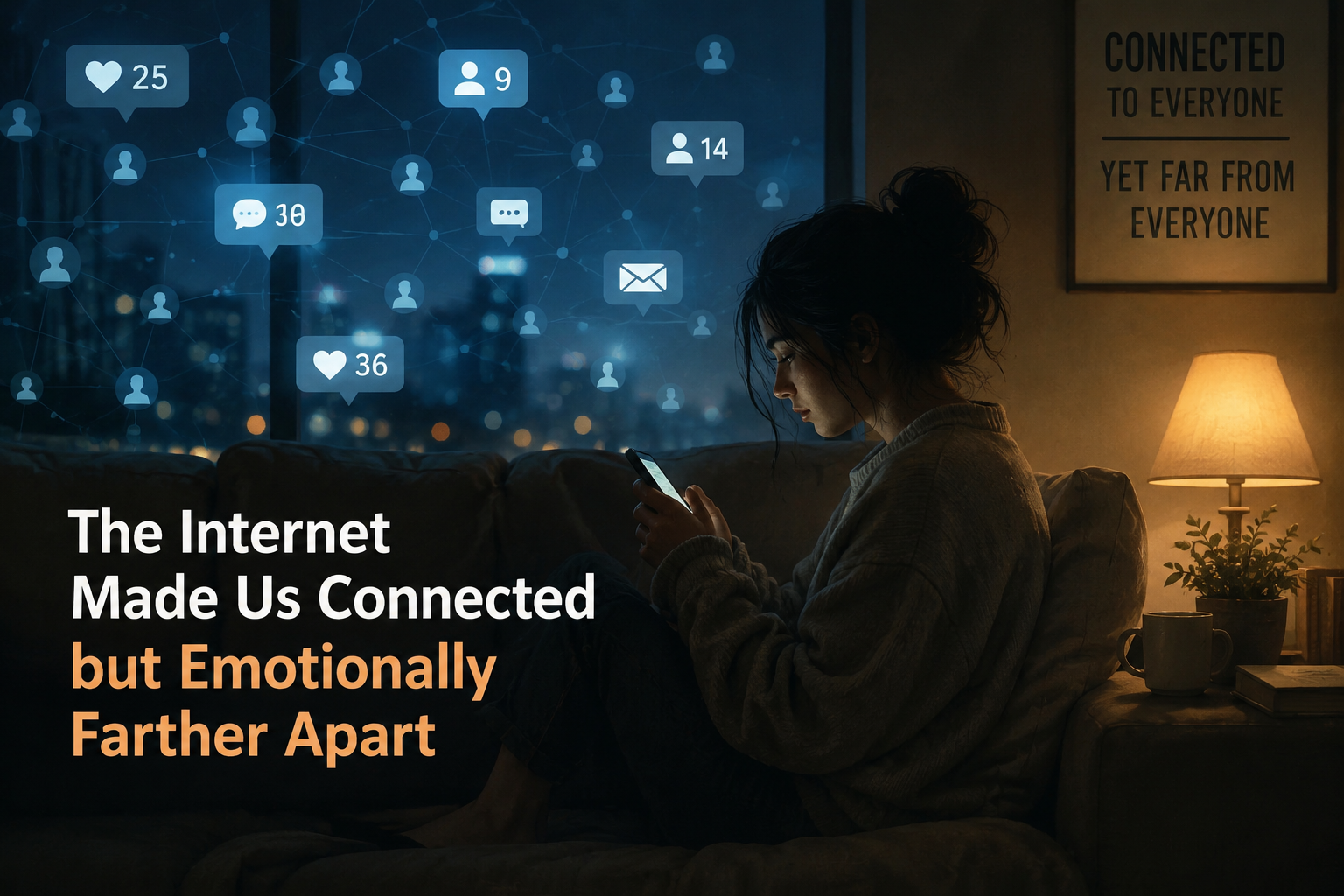
The internet promised connection, and technically, it delivered. We can reach almost anyone instantly. Old classmates reappear after ten years. Families separated by countries talk daily. You can post a thought at 2 a.m. and receive responses from strangers before falling asleep.
And yet, a lot of people quietly carry a kind of emotional emptiness that didn’t disappear with all this access.
That contradiction sits at the center of modern life. We are constantly connected, but many of us feel harder to reach emotionally than ever before.
Not isolated exactly. Just… distant.
The Difference Between Contact and Connection
One thing the internet did brilliantly was remove silence.
There’s almost never a moment now when nobody can reach us. Notifications fill tiny gaps that used to belong to boredom, reflection, or simple human presence.
But contact and connection are not the same thing.
You can exchange messages with twenty people in a day and still feel emotionally unknown. A group chat can stay active for years while nobody inside it actually says what they’re struggling with.
A lot of online interaction happens at surface level because surface level is easier to manage.
You react to someone’s story. Send a meme. Share a quick opinion. Maybe type “hope you’re okay” under a vague post before scrolling away thirty seconds later.
It creates the feeling of social activity without demanding emotional involvement.
And honestly, sometimes that’s fine. Not every interaction needs depth. But when most interactions start looking like that, something changes quietly over time.
People stop practicing vulnerability.
Not intentionally. It just becomes easier to perform a version of yourself than explain your real emotional state.
Especially online.
Social Media Turned Personality Into Presentation
There was a time when people mostly behaved differently in professional settings versus private life. Now the line feels blurry all the time.
Social media encourages constant self-presentation. Even people who claim not to care about it are affected by it in subtle ways.
You begin editing ordinary moments automatically.
Which photo looks effortless enough?
Does this caption sound too emotional?
Should I post this or does it make me look lonely?
Would people misunderstand this?
Over time, many people start managing perception before understanding themselves.
That sounds harsh, but it’s visible everywhere.
You see someone posting vacation photos daily while privately going through a breakup. Someone sharing motivational advice while emotionally exhausted. Someone appearing socially active online but barely speaking honestly to anyone offline.
And the strange thing is, most people already know this happens. We all understand social media is curated. Yet emotionally, we still compare our messy internal lives to other people’s edited external ones.
That comparison creates a quiet form of loneliness.
Not just because we envy others, but because we begin feeling unseen ourselves.
Being Available All the Time Changed Friendship
Friendships used to have natural pauses.
You missed people. You waited for conversations. Sometimes relationships deepened because effort was required to maintain them.
Now everyone is permanently reachable, but communication often feels thinner.
A lot of conversations happen in fragments throughout the day:
“Did you eat?”
“Look at this meme.”
“Sorry, busy today.”
“Lol.”
“Call later?”
Weeks pass like this.
There’s constant low-level interaction but very little emotional presence.
Ironically, permanent access can reduce intentional connection. Since people are always available in theory, nobody feels urgency to truly show up.
And then something uncomfortable happens during difficult periods of life.
You realize many people know your updates but not your actual emotional reality.
They saw your posts. They reacted to your stories. But they don’t really know what’s happening with you.
That gap can feel surprisingly lonely.
We Started Performing Happiness in Real Time
One of the saddest habits social media normalized is documenting experiences before fully living them.
You see it everywhere now.
Concerts watched through phone screens.
Friends pausing conversations for photos.
People filming emotional moments instead of staying inside them.
Sometimes it feels like modern life comes with an invisible second audience living inside our heads.
“How will this look online?”
Not every photo or post is fake, obviously. Humans naturally like sharing experiences. But the pressure to make life visible can slowly separate us from life itself.
There’s also exhaustion in constantly witnessing everyone else’s highlights.
A person can logically understand that social media is selective and still feel emotionally inadequate after scrolling for an hour.
The brain doesn’t process comparison rationally all the time.
You sit in your room feeling uncertain about your career while someone else announces promotions. You’re struggling emotionally while another person uploads smiling group photos every weekend. You feel stuck while everyone else appears to be moving forward beautifully.
Eventually, social media loneliness stops looking like dramatic isolation.
It starts looking like subtle emotional disconnection hidden beneath endless interaction.
The Internet Also Changed How We Listen
This part matters more than people admit.
Online spaces reward quick reactions, not careful listening.
Everything moves fast. Opinions appear instantly. Conversations become performances for invisible audiences. People interrupt emotionally before understanding context.
Even private conversations sometimes feel rushed now.
Someone shares something painful and the immediate response becomes advice, positivity, or distraction.
Very few people sit with discomfort anymore.
Partly because the internet trained us to consume emotions quickly. A sad video, a tragic headline, a breakup story, a motivational clip, then another meme five seconds later.
Human emotion becomes content flowing through a feed.
That affects real-world empathy too.
Not because people became cruel, but because constant exposure creates emotional fatigue. The mind protects itself by skimming instead of absorbing deeply.
And when nobody feels deeply heard, relationships begin feeling emotionally thinner.
Loneliness Looks Different Now
When people imagine loneliness, they often picture physical isolation.
Someone sitting alone in silence.
But modern loneliness often happens while surrounded by interaction.
It’s replying to messages all day while feeling emotionally detached.
It’s having hundreds of followers but nobody you want to call during a bad night.
It’s spending hours online and still feeling oddly invisible afterward.
A lot of people are socially saturated but emotionally undernourished.
And honestly, some of this isn’t entirely the internet’s fault. Human relationships have always been complicated. Technology simply amplified certain habits that were already there.
Avoidance became easier.
Comparison became constant.
Distraction became endless.
The internet didn’t invent loneliness. It just changed its shape.
Small Moments of Real Connection Feel Rarer Now
Maybe that’s why ordinary human moments feel unusually meaningful these days.
Someone putting their phone away during a conversation.
A friend noticing your mood without you explaining it.
A long walk without documenting it online.
A voice note that sounds emotionally real instead of socially polished.
These moments feel rare because attention itself has become fragmented.
People are tired mentally in ways that are difficult to describe. Not exhausted from physical labor necessarily, but from constant stimulation, comparison, updates, noise, opinions, and emotional overload.
Silence used to happen naturally. Now many people have to intentionally create it.
And inside silence, uncomfortable feelings finally catch up.
That may be one reason endless scrolling became so addictive. It postpones emotional confrontation.
You can avoid thinking about yourself for hours online.
Maybe We Forgot That Connection Requires Presence
Real connection has always required certain uncomfortable things:
Attention.
Patience.
Honesty.
Listening without multitasking.
Being emotionally available even when it’s inconvenient.
The internet optimized communication for speed, not depth.
That’s useful in many ways. Nobody genuinely wants to return to a world without digital access. The internet helps people learn, work, maintain relationships across distance, and find communities they might never discover otherwise.
For many people, online spaces genuinely reduce loneliness.
But connection still follows older emotional rules.
People want to feel seen without performance. Heard without rushing. Valued beyond usefulness or entertainment.
No algorithm can fully replace that.
And maybe that explains why some conversations stay with us for years while hundreds of online interactions disappear instantly from memory.
One carried emotional presence. The other carried information.
Those are not the same thing.
Conclusion
The internet connected humanity at a scale previous generations could barely imagine. That part is real. Lives changed because of it. Relationships survived because of it. Entire communities formed because of it.
But emotional closeness doesn’t automatically appear through access alone.
You can know what someone ate, where they traveled, what music they like, and still know almost nothing about their inner life.
That’s the strange loneliness many people quietly feel now.
Not absence of people.
Absence of depth.
Maybe the problem was never technology itself. Maybe it’s that human connection still moves slower than the internet allows.
And somewhere along the way, many of us forgot that being emotionally close to someone takes more than staying updated about them.
FAQs
What is social media loneliness?
Social isolation and social media loneliness refer to the feeling of emotional disconnection despite being constantly active online. A person may interact frequently on social platforms yet still feel unseen, emotionally distant, or isolated in real life.
Why do people feel lonely even when they are connected online?
Online interaction often focuses on quick updates, reactions, and curated content instead of deeper emotional communication. Constant contact does not always create genuine emotional closeness.
Can social media affect real-life relationships?
Yes. Excessive social media use can reduce attention, increase comparison, and weaken meaningful communication if it replaces real emotional presence. However, when used intentionally, it can also help maintain valuable relationships across distance.
0 Comments