
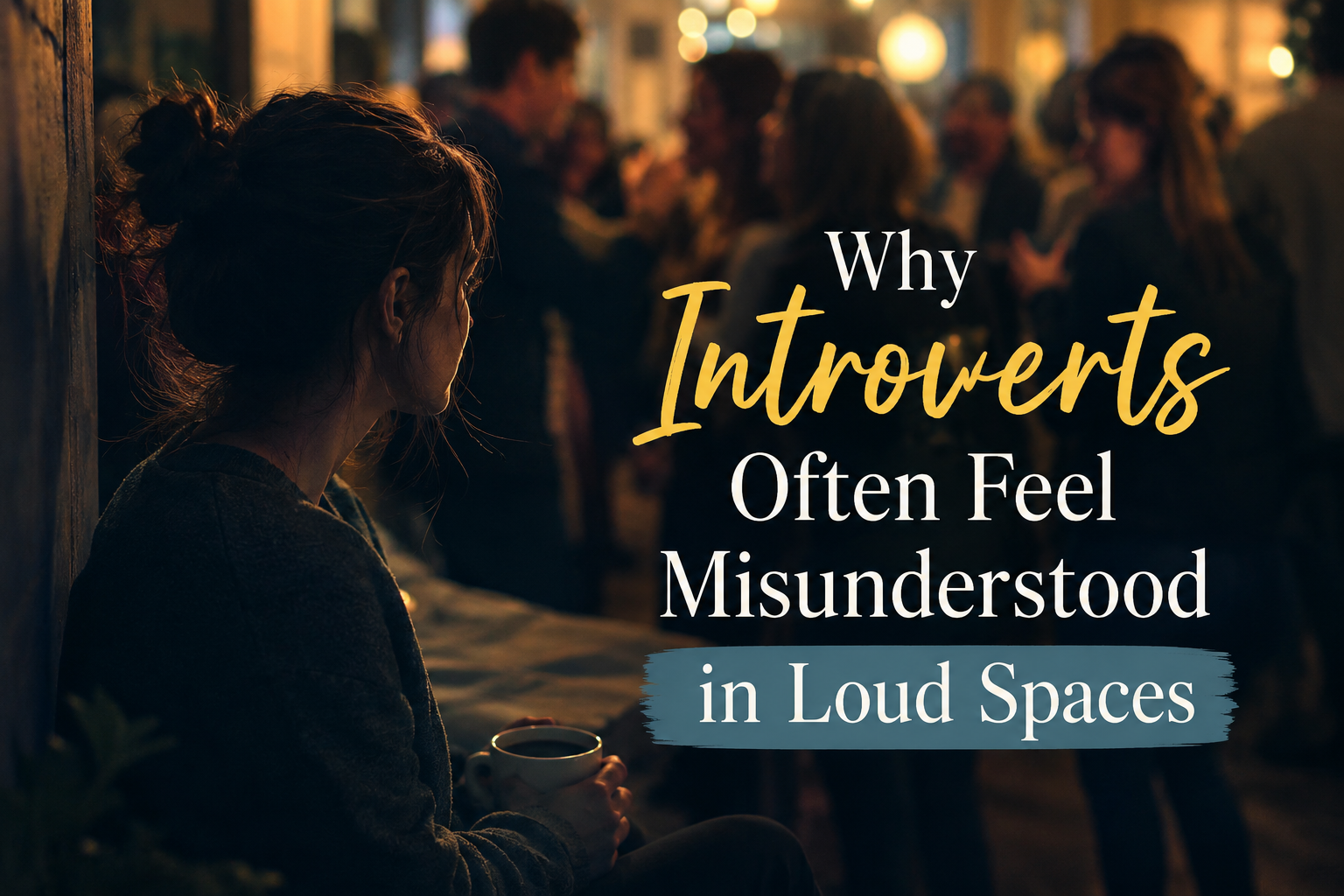
There’s a certain kind of exhaustion that doesn’t come from work, lack of sleep, or physical effort. It comes from spending hours in places where everyone seems louder than you.
A crowded family gathering. A busy office meeting. A birthday dinner where conversations overlap so aggressively that nobody finishes a sentence. Sometimes even a simple café can feel strangely draining when every table is competing to be heard.
For people with an introvert personality, loud spaces often create a quiet kind of disconnect. Not because introverts dislike people. That part gets misunderstood constantly. It’s more that certain environments ask them to perform a version of themselves that doesn’t come naturally.
And after a while, that performance becomes tiring.
A lot of introverts grow up hearing versions of the same comments:
“You’re too quiet.”
“Why don’t you talk more?”
“You should come out of your shell.”
It sounds harmless on the surface. Sometimes it even comes from people trying to help. But over time, those small remarks create a feeling that being naturally reserved is somehow incomplete.
Especially in spaces that reward volume.
Loud Spaces Reward Fast Reactions
Most social environments are designed around quick participation.
The loudest person gets noticed first. The fastest storyteller controls the conversation. People who interrupt confidently are often seen as charismatic instead of rude. In group settings, silence gets treated like absence.
An introvert personality usually works differently.
Many introverts process internally before speaking. They observe first. They think through responses. They often prefer depth over speed. In calm one-on-one conversations, this can make them thoughtful, attentive, and emotionally perceptive.
But in loud spaces, that same trait can make them disappear.
Not literally, of course. People see them sitting there. But socially, they become easy to overlook.
By the time an introvert has fully formed a thought, the group may already be three topics ahead.
It creates a strange experience where someone can spend an entire evening physically present while feeling mentally disconnected from the room.
And honestly, a lot of extroverted people never notice this happening.
Being Quiet Is Often Misread as Disinterest
One of the most frustrating things introverts deal with is how silence gets interpreted.
If someone talks constantly, people assume confidence.
If someone listens quietly, people often assume awkwardness, boredom, insecurity, or judgment.
But many introverts are deeply engaged while saying very little.
They notice small shifts in tone. They remember details other people forget. They pay attention to emotional undercurrents in conversations. Sometimes they’re absorbing far more than the loudest person in the room.
Still, because they aren’t visibly performing engagement, others misread them.
This misunderstanding starts early for a lot of people.
Teachers may describe quiet students as “not participating enough” even when they’re attentive. In workplaces, outspoken employees sometimes get viewed as stronger leaders regardless of actual competence. Socially, reserved people are occasionally treated like projects that need fixing.
The assumption underneath all of it is subtle but persistent:
Visible energy equals social value.
And that can make introverts feel like they are constantly failing some invisible personality test.
Group Conversations Can Feel Strangely Competitive
There’s an unspoken rhythm in many loud social settings. People jump in quickly, speak over each other, and compete for attention without fully realizing it.
Some people genuinely enjoy that energy. It energizes them.
For introverts, though, it can feel chaotic rather than exciting.
Not every introvert dislikes crowds, by the way. That stereotype is too simplistic. Plenty of introverts enjoy concerts, travel, parties, and public life. The issue is usually prolonged overstimulation, not hatred of people.
But group conversations often demand a type of social reflex that can become exhausting over time.
You may notice introverts pulling back gradually during loud events. First they contribute normally. Then they start listening more. Eventually they become observers while others carry the momentum.
People sometimes interpret this as moodiness.
Often, it’s just fatigue.
There’s also another layer that rarely gets talked about. Loud spaces tend to reward surface-level interaction. Quick jokes. Fast opinions. Short reactions.
Many introverts naturally lean toward slower conversations with more substance. They usually connect better through smaller moments rather than group performance.
That kind of connection is harder to find in noisy environments where nobody sits still long enough to go deeper.
Introverts Often Spend Years Pretending
A lot of introverted adults become surprisingly good at acting extroverted.
You can see it in workplaces especially.
They learn to smile through networking events. They rehearse small talk. They train themselves to appear energetic during meetings. Some even become socially skilled enough that people stop believing they’re introverts at all.
But social ability and social energy are not the same thing.
That distinction matters.
An introvert personality doesn’t automatically mean shyness, poor communication, or social anxiety. Some introverts are excellent speakers. Some are performers. Some lead teams confidently.
The difference usually appears afterward.
Extroverted people often gain energy from heavy social interaction. Introverts typically lose energy from it, even if they enjoy the experience itself.
That’s why many introverts need quiet recovery time after long social events. Not because they hated everyone there. Their nervous system simply gets overloaded faster.
Unfortunately, this recovery need is sometimes judged harshly.
People may call them antisocial for leaving early. Friends might take declined invitations personally. Family members may assume withdrawal means emotional distance.
Meanwhile, the introvert is often just trying to feel mentally balanced again.
Modern Culture Quietly Glorifies Extroversion
A lot of modern culture favors extroverted behavior without openly admitting it.
Open office layouts reward constant interaction. Social media rewards visibility and quick reactions. Networking culture encourages endless self-promotion. Even productivity advice often assumes people should always be collaborative, available, and socially “on.”
There’s an underlying pressure to appear energetic all the time.
And if you naturally operate differently, you can start questioning yourself.
Some introverts end up forcing personalities that don’t fit them because they think quietness looks weak. They overtalk in meetings. They stay longer at gatherings than they want to. They say yes to constant social plans even when exhausted.
Eventually, many hit a wall.
Not dramatically. Just quietly.
They start feeling emotionally tired in ways they can’t fully explain.
Part of the problem is that introversion is still often framed as something to overcome instead of simply understand.
You can see this in casual advice people give.
“Just put yourself out there.”
“Fake confidence.”
“Be more outgoing.”
Some of that advice can genuinely help in certain situations. Growth matters. Avoiding all discomfort forever isn’t healthy either.
But constantly treating introvert personality traits as flaws creates unnecessary shame around natural temperament.
Not every quiet person is secretly waiting to become loud.
The Loneliness of Feeling Misread
One of the hardest parts about being misunderstood isn’t criticism. It’s invisibility.
Introverts often feel unseen in environments dominated by louder personalities because their strengths are less obvious at first glance.
Listening carefully doesn’t draw attention.
Thinking before speaking doesn’t dominate rooms.
Being calm rarely becomes the center of social energy.
But these traits matter deeply in real relationships.
Some of the safest people to talk to are quiet listeners. Some of the most emotionally intelligent people in a group are the ones speaking the least. Many introverts create intimacy not through performance, but through consistency and attention.
The problem is that loud environments rarely pause long enough to notice these qualities.
So introverts sometimes leave spaces feeling oddly lonely even after being surrounded by people for hours.
That feeling is difficult to explain unless you’ve experienced it yourself.
It’s not exactly rejection.
It’s more like existing slightly outside the rhythm everyone else seems naturally synced to.
Quietness Is Not Emptiness
There’s a misconception that people who speak less must somehow feel less.
In reality, many introverts have intensely active inner lives.
They reflect deeply. They replay conversations afterward. They notice emotional subtleties others miss. Sometimes they experience environments more intensely precisely because they absorb so much at once.
Quietness is often fullness, not emptiness.
And honestly, society could benefit from recognizing that more often.
Not every meaningful person enters a room loudly.
Not every intelligent thought arrives instantly.
Not every form of confidence looks charismatic.
Some people contribute through steadiness rather than presence.
Once you understand that, introverts stop seeming mysterious. They simply operate differently in environments built around noise.
Conclusion
Loud spaces are not inherently bad. Neither are extroverted personalities. Human connection would feel pretty empty without energetic people who bring movement and openness into rooms.
But problems begin when only one style of being human gets treated as socially correct.
An introvert personality often carries strengths that become invisible in noisy environments. Reflection. Depth. Observation. Emotional attentiveness. Careful thinking.
These traits rarely compete well in fast, loud spaces. Still, they matter.
Probably more than people realize.
And maybe introverts feel misunderstood not because they are difficult to understand, but because modern culture often listens only to whoever speaks first.
FAQs
What is an introvert personality?
An introvert personality generally describes someone who tends to recharge through solitude or quieter environments rather than constant social stimulation. Introverts are not necessarily shy or antisocial. Many enjoy socializing but need downtime afterward to recover mentally.
Why do introverts feel exhausted in crowds?
Crowded or loud environments often create sensory and social overstimulation for introverts. Constant interaction, noise, and fast-paced conversation can drain mental energy over time, even when the experience itself is enjoyable.
Are introverts socially awkward?
Not necessarily. Many introverts are socially skilled and confident. The difference is usually about energy and communication style, not ability. Introverts often prefer deeper conversations and smaller social settings over highly stimulating group environments.
0 Comments