
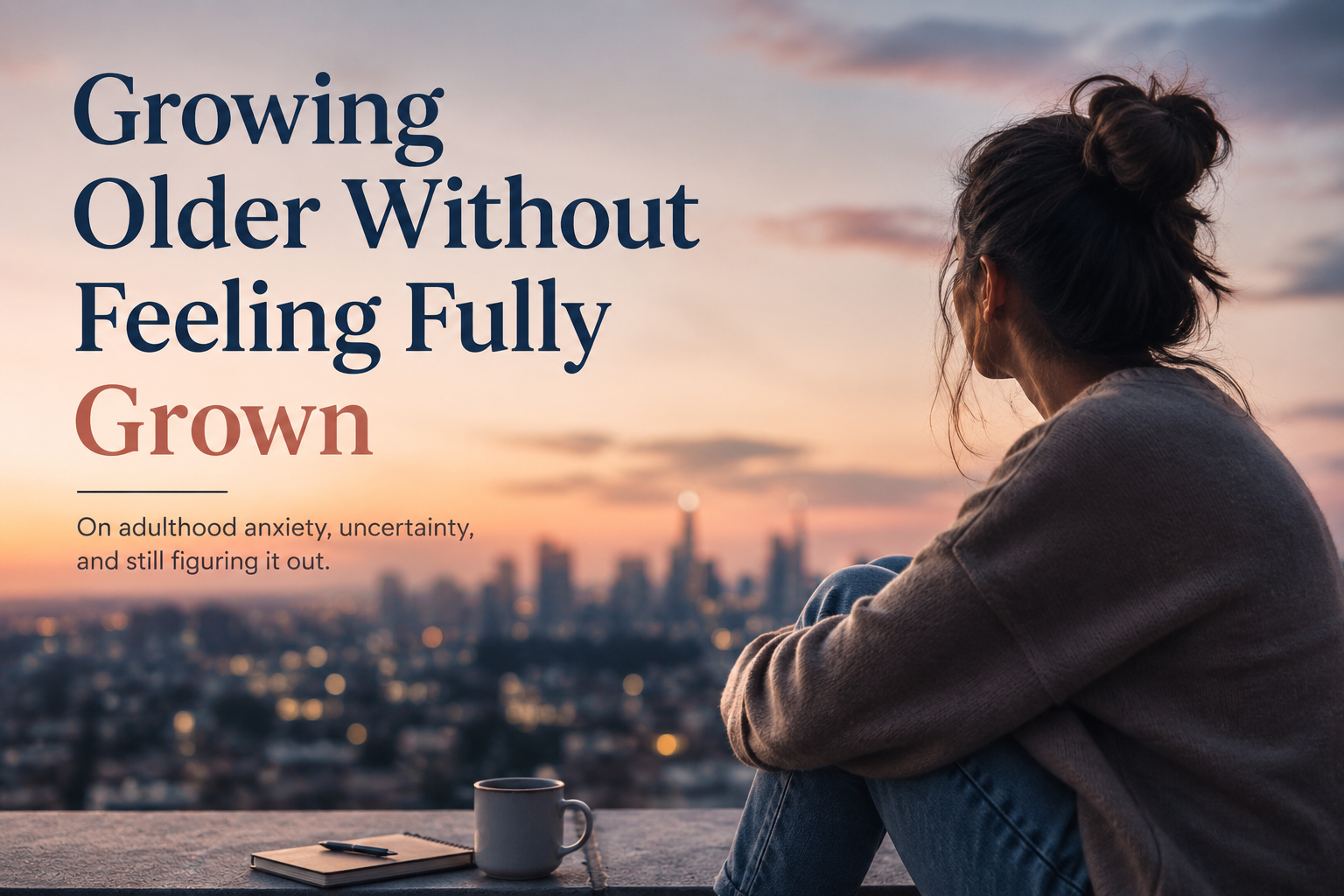
Introduction
I used to think adulthood would arrive all at once.
Not legally. Not on paper. I mean emotionally. I thought one morning I’d wake up and suddenly feel certain about things. Bills would stop feeling confusing. Decisions would stop feeling heavy. I’d know what kind of person I was becoming. Maybe I’d even enjoy grocery shopping without feeling mildly lost inside a supermarket aisle.
Instead, adulthood arrived quietly and in pieces.
You learn how to schedule appointments while still feeling sixteen during awkward conversations. You pay electricity bills and then spend twenty minutes wondering if you accidentally offended someone in a text message. You become responsible for serious things while still feeling emotionally unfinished in strange, embarrassing ways.
And nobody really warns you about that part.
A lot of adulthood anxiety comes from this gap between appearance and feeling. From the outside, people look stable. Functional. Certain. But privately, many of us are improvising our way through life while pretending we understand the script better than we actually do.
Growing older is obvious. Feeling fully grown is something else entirely.
The Moment You Realize Nobody Fully Knows What They’re Doing
There’s a specific kind of shock that happens in your twenties and thirties.
You start noticing that adults you admired when you were younger were also guessing their way through things. Teachers. Parents. Managers. Older cousins who once seemed impossibly mature.
Not recklessly. Not incompetently. Just… human.
When you’re younger, adulthood looks solid from a distance. People appear emotionally organized. Confident. Sure of themselves. But once you get older, you begin seeing the cracks that were always there.
The parent who quietly worried about money every month.
The uncle who changed careers three times.
The friend who looks successful online but still panics before making simple life decisions.
The older you get, the more you realize maturity is less about certainty and more about functioning despite uncertainty.
That realization is oddly comforting, though it can also make adulthood anxiety worse for a while. Because if nobody truly “arrives,” then what exactly are we waiting for?
Some Parts of You Stay the Same for Years
One thing people rarely talk about is how emotionally uneven growing up can feel.
Certain parts of you mature quickly. Other parts seem frozen in time.
You learn patience after difficult experiences. You become more thoughtful with money. You get better at reading people. But maybe you still feel twelve years old when someone raises their voice at you. Maybe family gatherings still pull you back into old insecurities you thought you had outgrown.
That disconnect can feel embarrassing.
You think, “Shouldn’t I be past this by now?”
But human beings don’t grow in straight lines. Emotional growth is messy. It loops backward sometimes. You can be deeply mature in one area of life and completely uncertain in another.
A person can handle workplace pressure calmly yet still feel anxious making phone calls.
Someone can raise children while privately feeling emotionally unfinished themselves.
That’s more common than people admit.
The Quiet Pressure to Have Your Life Together
A huge part of adulthood anxiety comes from invisible timelines.
By a certain age, you’re supposed to know what career you want. You’re supposed to become emotionally stable. Financially responsible. Mentally clear. Socially established. Maybe married. Maybe successful in ways that photograph well.
Even people who reject those expectations still feel them hovering nearby.
You notice it during casual conversations.
“What’s next for you?”
“Are you planning to settle down?”
“Where do you see yourself in five years?”
Sometimes these questions sound harmless. But when you already feel uncertain, they can make your entire life feel like a delayed project.
And honestly, modern adulthood is confusing in ways previous generations didn’t always experience in the same way. People change careers multiple times. Relationships are less predictable. Stability feels expensive. Many people are emotionally exhausted long before they feel established.
So you end up in this strange emotional space where you’re technically an adult but still feel like you’re waiting for your real life to begin.
Small Moments That Make You Feel Weirdly Young
Adulthood anxiety rarely appears in dramatic ways.
Usually it shows up quietly.
Standing in a pharmacy reading medicine labels like they’re written in another language.
Calling customer support and rehearsing what you’ll say beforehand.
Feeling oddly proud after cooking a decent meal for yourself.
Looking around during serious conversations and wondering how everybody else seems so composed.
Sometimes it happens during family events. Older relatives speak to you as if you’re fully grown now, but internally you still feel connected to younger versions of yourself. You remember childhood emotions vividly. Old fears. Old dreams. Old confusion.
The body ages faster than the mind adjusts.
And honestly, I think many people carry multiple ages inside them at once. The current version of themselves. The younger self they protect. The exhausted self they hide. The hopeful self they’re trying not to lose.
That doesn’t disappear just because you learn how taxes work.
Social Media Made Adulthood Feel Like a Performance
There’s another layer to this now that didn’t exist in quite the same way before.
We constantly see curated versions of other people’s adulthood.
Engagement photos. Apartment tours. Promotions. Productive morning routines. Perfectly organized bookshelves beside expensive coffee machines.
Even when we know it’s selective, it still affects us.
You start measuring your ordinary life against somebody else’s highlight reel. And adulthood anxiety grows quietly inside those comparisons.
Meanwhile, many people posting polished lives are privately overwhelmed too.
A person can look successful online while feeling emotionally burnt out offline.
A couple can appear stable in photos while barely communicating properly.
Someone can post motivational captions while having panic attacks at night.
That doesn’t mean people are fake. It just means public life and private life are rarely identical.
Still, repeated exposure to polished adulthood can make your own uncertainty feel abnormal when it really isn’t.
Maybe Adulthood Is Less About Arrival
I think one of the hardest things to accept is that adulthood may never feel complete.
There may not be a final stage where fear disappears and confidence permanently settles in.
Instead, people slowly become more familiar with themselves. That’s different from becoming perfect.
You learn which anxieties are temporary. You learn how to recover from mistakes faster. You become less shocked by disappointment. You stop expecting yourself to feel emotionally certain all the time.
That’s maturity too.
Not confidence every day. Just resilience.
And honestly, some of the people who seem most “grown up” are simply better at carrying uncertainty without letting it consume them.
They still worry. They still doubt themselves. They still feel lost sometimes. They’ve just stopped treating uncertainty as proof of failure.
That shift matters.
The Strange Grief of Leaving Younger Versions of Yourself Behind
There’s also sadness hidden inside growing older.
Not dramatic sadness. Quieter than that.
You realize certain phases of life are gone forever before you fully appreciated them. School friendships become memories. Family routines change. Familiar places disappear. Some dreams quietly expire without ceremony.
Meanwhile, you’re expected to keep moving forward confidently.
But emotionally, people often carry grief for past versions of themselves while trying to build future versions at the same time.
That emotional overlap creates tension.
You’re grieving who you were while trying to become someone else.
No wonder adulthood feels emotionally crowded sometimes.
What Actually Helps
Not productivity hacks. Not fake positivity.
Usually, what helps is smaller and less glamorous.
Having a few honest conversations with people who admit they’re confused too.
Realizing stability is often quieter than success.
Learning that progress sometimes looks like handling things slightly better than you did last year.
Giving yourself permission to be unfinished.
That last one matters more than people think.
A lot of adulthood anxiety comes from believing you should already be complete by now. But most people are still becoming themselves well into their thirties, forties, fifties, and beyond.
Human beings keep changing. Sometimes painfully. Sometimes beautifully.
There’s no age where growth suddenly ends.
Conclusion
Growing older without feeling fully grown can feel isolating until you realize how common it actually is.
A surprising number of adults are carrying uncertainty beneath their routines. They go to work, answer emails, make appointments, pay bills, and still quietly wonder if they’re doing life correctly.
Maybe adulthood isn’t a finished identity people eventually unlock.
Maybe it’s just learning how to live honestly while incomplete.
Not every fear disappears. Not every question gets answered. But over time, many people become softer with themselves. Less performative. Less desperate to appear certain all the time.
And maybe that’s closer to real maturity than we were taught to believe.
FAQs
What is adulthood anxiety?
Adulthood anxiety refers to the stress, uncertainty, and emotional pressure many people feel while trying to manage adult responsibilities, relationships, finances, and identity. It often includes feeling unprepared despite growing older.
Why do I still feel immature as an adult?
Feeling emotionally unfinished is very common. People grow differently in different areas of life. You may be responsible in some ways while still carrying insecurities, fears, or confusion from earlier stages of life.
Does adulthood ever start feeling easier?
For many people, adulthood doesn’t become perfectly clear or easy. What usually changes is emotional resilience. Over time, people often become better at handling uncertainty and accepting that nobody fully has everything figured out.
0 Comments