
Somewhere along the way, being constantly tired became normal.
People answer messages while eating. Watch shows while scrolling. Work during weekends and feel guilty while resting. Even hobbies started sounding productive. Reading became “self-improvement.” Walking became “step goals.” Sleep became another thing to optimize.
And quietly, without fully noticing it, many people stopped experiencing their own lives properly.
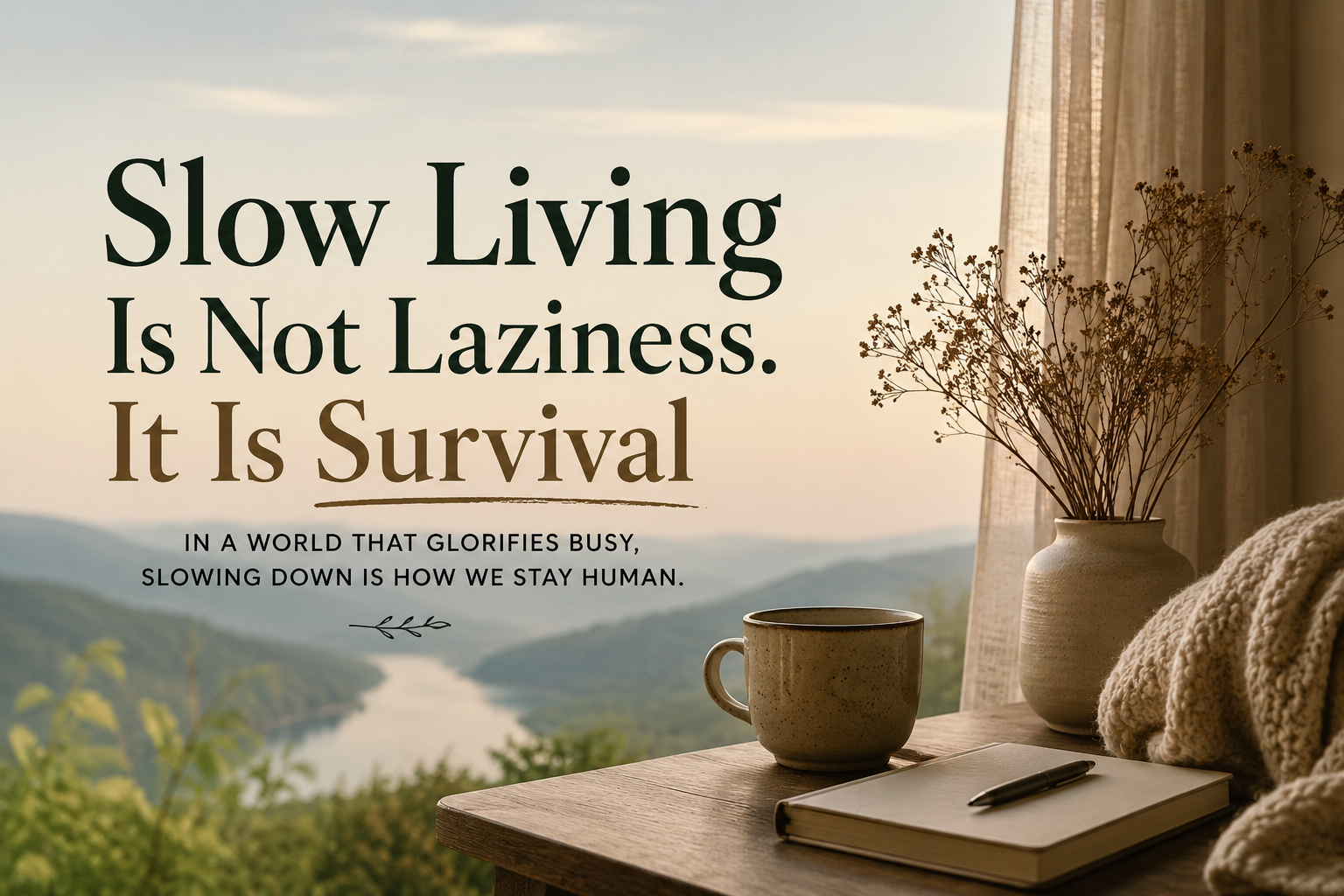
The slow living lifestyle gets mocked sometimes because it looks unambitious from the outside. People hear “slow living” and imagine someone avoiding responsibility, moving to the countryside, drinking expensive coffee beside a plant-filled window while somehow surviving without deadlines.
But most people who are trying to slow down are not escaping life.
They are trying to recover from it.
That distinction matters.
Because for a growing number of people, slowing down is no longer about aesthetics or trends. It is damage control. A way to stay emotionally functional in a culture that treats exhaustion like proof of seriousness.
The Pace We Started Accepting
A lot of modern life runs on invisible pressure.
No one explicitly tells you to answer emails immediately, keep up with every trend, stay reachable all the time, maintain a perfect social life, improve your body, earn more money, build a personal brand, and somehow remain mentally stable through all of it.
But the pressure is there anyway.
You feel it when your phone lights up during dinner and your body reacts before your mind does.
You feel it when resting for one afternoon creates guilt instead of relief.
You feel it when every quiet moment gets filled automatically with noise because silence itself has started feeling uncomfortable.
People are overstimulated in ways that are difficult to explain unless you have experienced it yourself. Not dramatic burnout necessarily. Sometimes it shows up as smaller things.
Forgetting simple tasks.
Feeling oddly irritated by harmless conversations.
Being unable to focus on books anymore.
Feeling mentally crowded all the time.
There is also this strange exhaustion that comes from never fully arriving anywhere mentally. Your body sits in one place while your attention keeps jumping between tabs, notifications, unfinished thoughts, and future worries.
A lot of people are technically resting now without actually recovering.
That is part of the problem.
Slow Living Is Often Misunderstood
The internet sometimes turns slow living lifestyle content into a visual performance.
Soft music. Ceramic mugs. Linen clothes. Morning routines filmed near large windows.
None of that is wrong. But it can make slow living seem decorative instead of practical.
Real slow living is much less glamorous.
Sometimes it simply means cooking one proper meal instead of ordering food because you are too mentally drained to decide.
Sometimes it means not forcing yourself to attend every social event when your brain already feels overloaded.
Sometimes it means leaving your phone in another room for an hour and realizing how restless you have quietly become.
And honestly, sometimes it means accepting that your nervous system cannot keep functioning at maximum speed forever.
People often confuse slowing down with giving up. They are not the same thing.
Laziness avoids effort altogether.
Slow living asks a different question: what effort is actually worth your life energy?
That question changes people.
The Strange Fear of Doing Less
Many people do not know how to rest anymore without defending it.
You can see it in conversations.
“I’ve been so busy lately.”
“I barely slept this week.”
“I’m exhausted.”
These statements are often exchanged almost like achievements. As if suffering proves importance.
Meanwhile, someone who protects their time too carefully risks looking unserious or unmotivated.
There is a reason people apologize before taking breaks.
Somewhere deep down, many adults absorbed the idea that slowing down equals falling behind.
And falling behind feels dangerous.
Financially, socially, emotionally. Even digitally.
The pace of everything now creates a strange fear that if you stop moving for a second, the world will move on without you.
So people keep pushing.
Even when their bodies clearly disagree.
You see people answering work calls while sick. Taking laptops on vacations they cannot enjoy. Watching sunsets through phone cameras instead of their own eyes because documenting life has started replacing participation in it.
It sounds small until you realize how often it happens.
Your Body Usually Knows Before Your Mind Does
One thing people rarely admit is that the body notices burnout earlier than the mind.
Your attention span shortens.
You stop feeling excitement properly.
You wake up tired after full sleep.
Tiny inconveniences feel emotionally huge.
You begin craving silence without understanding why.
Some people suddenly become emotional over random things. Others become numb instead. Neither response is unusual.
The body keeps score in quiet ways.
A person can continue functioning publicly while privately feeling disconnected from themselves for months.
That is why the slow living lifestyle appeals to people who never imagined themselves wanting it before. Not because they became less ambitious. Because constant acceleration started costing too much psychologically.
There is a point where efficiency stops improving life and starts consuming it.
A lot of people are standing at that point right now.
Slowing Down Changes What You Notice
One unexpected thing about slowing down is how much you begin seeing again.
Not in some magical spiritual sense. Just ordinary human observation.
You notice how rushed conversations have become.
You notice how often people interrupt silence immediately.
You notice how many meals are eaten while staring at screens.
You notice your own habits too. The reflex to check notifications during quiet moments. The inability to sit still without reaching for stimulation.
At first, this awareness can feel uncomfortable.
Then gradually, something else happens.
Life starts feeling slightly more solid again.
Not perfect. Not peaceful every second. Just more real.
You drink tea while it is still hot instead of forgetting it on your desk for the fourth time.
You walk somewhere without headphones occasionally and hear your own thoughts again.
You read slower. Eat slower. Respond slower.
And strangely, some things become more enjoyable precisely because they are no longer rushed past.
People underestimate how healing ordinary moments can feel when your nervous system is not overloaded constantly.
Slow Living Does Not Mean Escaping Responsibility
This part matters because slow living gets criticized unfairly sometimes.
Slowing down does not mean abandoning ambition, discipline, or goals.
It means refusing to destroy yourself in the process of pursuing them.
There are people working demanding jobs who still practice forms of slow living. They protect evenings. They take walks without multitasking. They avoid turning every free hour into productivity. They say no sometimes without inventing excuses.
That is still slow living.
You do not need a farmhouse, flexible income, or a minimalist apartment filled with beige furniture.
Most people practicing this are ordinary people trying to create a little more breathing room inside normal lives.
Parents doing fewer unnecessary commitments.
Workers setting phone boundaries after office hours.
Students learning that burnout is not academic dedication.
Writers allowing themselves to think slowly instead of producing constantly.
The slow living lifestyle is less about appearance and more about attention.
Where your attention goes shapes your experience of being alive.
That sounds obvious until you realize how fragmented modern attention has become.
There Is A Difference Between Existing And Living
A lot of people are technically functioning while emotionally absent from their own lives.
Days blur together.
Weeks disappear strangely fast.
You keep postponing rest until after the next deadline, next project, next stressful phase. Then another one arrives immediately.
People survive like this for years sometimes.
And eventually they reach moments where they cannot explain why they feel empty despite doing everything correctly on paper.
Because human beings are not machines built only for output.
Life cannot be experienced properly at permanent speed.
Some of the most meaningful parts of being alive happen slowly anyway. Trust. Friendship. Recovery. Grief. Creativity. Love. Understanding yourself.
None of these things respond well to constant rushing.
You cannot optimize your way into feeling connected to your own existence.
At some point, slowing down stops being a luxury and becomes maintenance for being human.
Conclusion
The slow living lifestyle is not about rejecting modern life completely. Most people cannot disappear into forests and abandon responsibilities even if they wanted to.
It is about noticing when your pace has stopped feeling sustainable.
It is about protecting parts of yourself from being consumed entirely by urgency, noise, and constant pressure to perform.
Some people will still call that laziness because modern culture often rewards visible exhaustion more than quiet balance.
But a person does not need to earn rest by collapsing first.
And honestly, many people are not slowing down because life became easy.
They are slowing down because continuing at full speed started hurting in ways they could no longer ignore.
That is not laziness.
That is survival.
FAQs
What is a slow living lifestyle?
A slow living lifestyle focuses on being more intentional with time, energy, and daily habits. It encourages people to reduce unnecessary rushing and create space for rest, attention, and meaningful routines.
Is slow living the same as being lazy?
No. Laziness avoids responsibility completely. Slow living is about managing energy more consciously and avoiding constant burnout. Many people who practice slow living still work hard and pursue goals.
How can someone start slow living realistically?
Start small. Eat one meal without screens. Take short walks without multitasking. Protect part of your evening from work or social media. Slow living usually begins with small changes in attention, not dramatic lifestyle overhauls.
0 Comments