
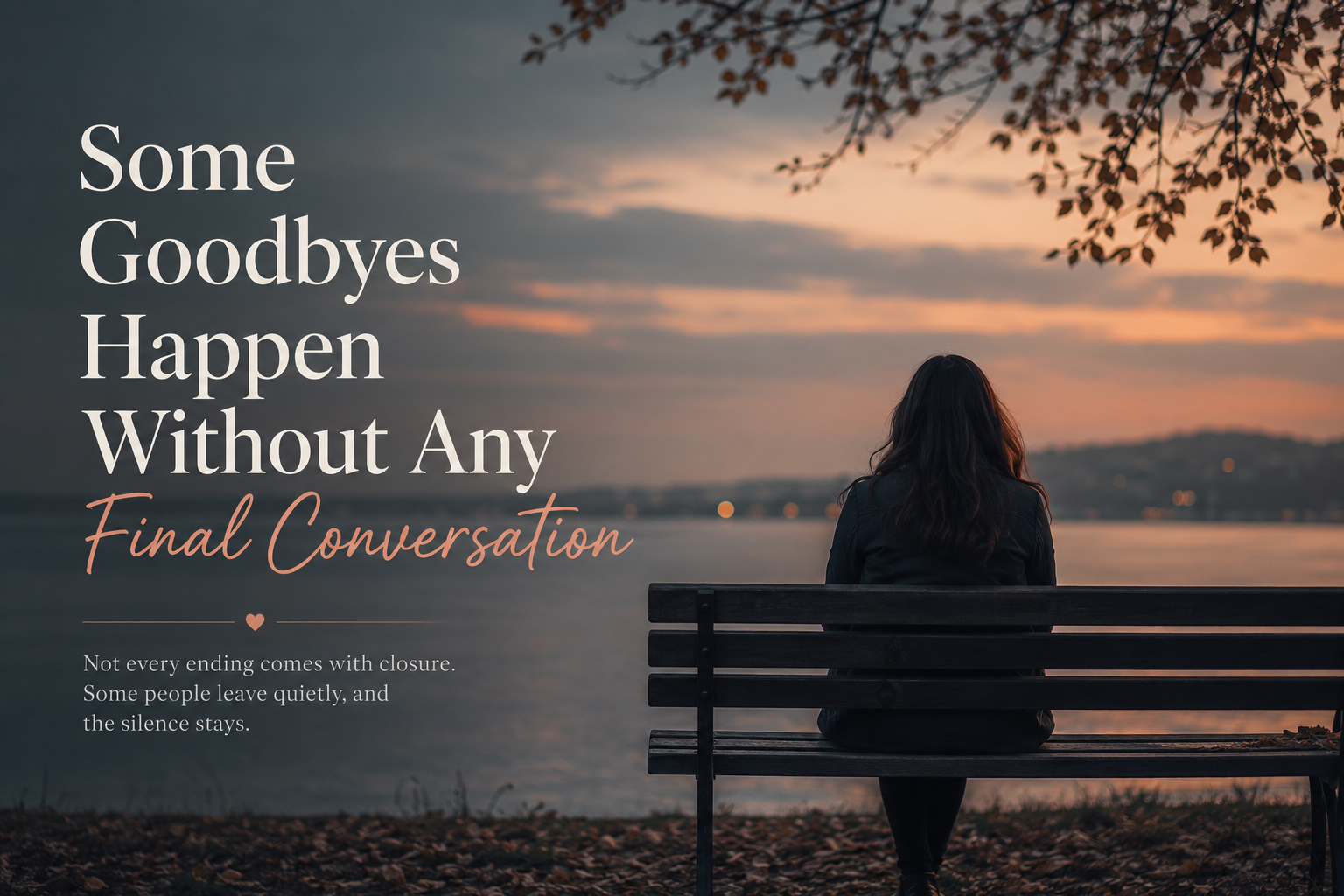
Most people imagine goodbyes as dramatic things.
A final phone call. A long message. Someone standing at a train station trying not to cry. Maybe even anger loud enough to make the ending feel official.
But a lot of relationships do not end that way.
Sometimes people simply drift out of each other’s lives without announcing it. No argument sharp enough to point at. No final explanation. Just slower replies, postponed plans, shorter conversations, and eventually silence that becomes permanent before either person fully notices it happening.
A silent goodbye can feel strangely unfinished because there is no clear moment to grieve. You keep thinking the conversation will resume next week. Then next month. Then someday when life settles down.
And then one afternoon, maybe while cleaning your gallery or hearing an old song in a grocery store, you realize the relationship is already gone.
Not ruined. Not buried dramatically.
Just gone quietly.
That kind of ending stays with people longer than they expect.
The Relationships That Fade Instead of Break
Some relationships end like slammed doors.
Others end like a light dimming slowly in another room.
You still remember the person. You still care in some small hidden corner of yourself. But the rhythm between you disappears little by little until reaching out starts to feel awkward.
At first, the silence seems temporary.
Someone gets busy with work. Someone moves cities. Someone starts dating another person. Life becomes crowded. Days blur together. Nobody means to disappear completely.
But humans adapt quickly to absence.
That is the uncomfortable part.
You can spend years speaking to someone every single day, then suddenly go months without hearing their voice. Eventually the brain stops expecting their messages. Their name moves lower in your contacts. You stop checking if they viewed your story.
Not because they stopped mattering overnight. Mostly because life keeps moving whether people are emotionally ready or not.
A silent goodbye often happens through accumulated neglect rather than deliberate cruelty.
And honestly, that is what makes it harder to process.
There is no villain to blame.
When There Is No Real Closure
People talk about closure as if it is something another person hands you politely before leaving.
Real life rarely works like that.
Sometimes you never get the explanation you think you deserve. Sometimes the last conversation you had with someone was painfully ordinary.
You discussed groceries. A TV show. Weekend plans. Something forgettable.
You did not know it would be the final normal moment.
That can haunt people for years. Not because the conversation itself mattered, but because humans naturally search for symbolic endings. We want a scene that confirms the chapter is over.
Without that, the mind keeps reopening the door.
Maybe they will text someday.
Maybe things just became complicated.
Maybe this is temporary.
A silent goodbye keeps tiny possibilities alive longer than necessary.
And sometimes those possibilities prevent grief from fully settling.
The Strange Pain of Unsent Messages
Almost everyone has typed a message they never sent.
Sometimes it is pride. Sometimes fear. Sometimes exhaustion.
You stare at the screen wondering whether reconnecting would feel genuine or simply desperate. You rewrite simple sentences too many times.
“Hey, how have you been?” suddenly feels emotionally dangerous.
There is also the fear of discovering the other person already moved on completely.
That fear keeps many silent goodbyes permanently unfinished.
People imagine heartbreak as explosive emotion, but often it looks much smaller than that. It looks like deleting a paragraph before sending it. It looks like opening an old chat late at night and closing it again. It looks like seeing someone’s birthday reminder and pretending not to notice.
Quiet grief hides inside ordinary habits.
Some People Leave Long Before They Physically Go
One difficult thing about relationships is that emotional distance usually appears before actual separation.
You can feel someone slowly withdrawing even while conversations still happen.
Replies become functional instead of warm. They stop telling you random details about their day. The energy changes first. The silence comes later.
A lot of people sense this happening but avoid discussing it because naming distance makes it real.
So both people continue acting normal while quietly preparing for absence.
That emotional limbo is exhausting.
You sit across from someone who technically still exists in your life, yet something essential already feels missing. Like a room after furniture has been removed. The structure remains, but the warmth changed.
Not every silent goodbye is intentional. Some people are overwhelmed. Some are emotionally avoidant. Some simply outgrow old versions of themselves and do not know how to explain it kindly.
Still, even understandable endings can hurt deeply.
Understanding pain does not erase it.
Memory Becomes Unusually Sharp After Quiet Endings
It is strange what the mind chooses to keep.
After a silent goodbye, people rarely obsess over major moments first. Instead, tiny details stay alive.
The way someone laughed while drinking water. The exact phrase they used when annoyed. A familiar typing pattern. The sound of their footsteps outside your door.
Small memories become emotional landmarks because there was no dramatic ending large enough to replace them.
And because the relationship faded instead of exploded, the memories remain mostly untouched by anger.
That creates a different kind of sadness.
Cleaner. Softer. Harder to hate.
Sometimes you miss the version of yourself that existed around that person too. Certain friendships and relationships unlock specific parts of our personality. When the connection disappears, those versions quietly disappear with it.
People do not talk about that enough.
Social Media Makes Silent Goodbyes Stranger
Years ago, when people left your life, they actually disappeared.
Now they remain visible in fragments.
You see a new haircut. A vacation photo. A random achievement. Proof that their life continues without your involvement.
Not close enough to speak. Not distant enough to forget.
That strange middle ground can stretch for years.
Sometimes people become accidental spectators in each other’s lives. Former best friends reacting silently to stories. Old partners watching birthdays pass from a distance. Nobody reaching out. Nobody fully disconnecting either.
It creates emotional loose ends that never tighten properly.
And honestly, social media encourages emotional hovering. People linger around old relationships digitally long after the real connection has ended.
A silent goodbye becomes harder to accept when reminders appear every few weeks between recipes and memes.
Not Every Relationship Is Meant to Return
There is a comforting fantasy many people hold onto: that meaningful relationships always find their way back eventually.
Sometimes they do.
A lot of times they do not.
That is not cynicism. It is simply adulthood.
People change environments, priorities, beliefs, emotional capacities. Timing matters more than most people admit. Two people can care about each other sincerely and still fail to remain present in each other’s lives.
Not every lost connection needs a dramatic reconciliation arc.
Some relationships are temporary without being meaningless.
That can be difficult to accept because modern culture tends to divide relationships into success or failure. But many human connections exist somewhere in between.
Some people were only meant to walk beside you during one particular version of your life.
The ending does not erase what was real about it.
The Older You Get, The More Quiet Endings You Notice
As people grow older, friendships often stop ending through conflict.
They end through exhaustion, relocation, marriage, parenthood, work schedules, emotional burnout, or simply incompatible lives.
Nobody announces it formally.
One day you realize you keep remembering someone you no longer truly know.
That realization can feel surprisingly lonely.
Especially when the friendship once felt permanent.
Youth makes people believe closeness automatically sustains itself. Adulthood teaches otherwise. Relationships require maintenance, emotional availability, and timing that sometimes people simply cannot give anymore.
And still, even knowing that logically does not make silent goodbyes easier emotionally.
Humans are not built to detach neatly.
Conclusion
A silent goodbye leaves behind a very specific kind of ache.
Not loud grief. Not cinematic heartbreak.
Something quieter than that.
It lives in unfinished thoughts and small memories. In conversations that slowly disappeared without either person officially ending them. In moments where you almost reach out but stop yourself halfway.
Maybe that is why these endings stay with people for so long. There is no clean line dividing before and after. The relationship fades gradually, and part of you keeps expecting it to return long after it already ended.
But not every meaningful connection gets a final chapter written properly.
Some people leave softly.
Some relationships dissolve mid-sentence.
And sometimes the last conversation feels completely ordinary until years later when you realize it was the last one after all.
FAQs
What is a silent goodbye?
A silent goodbye is when a relationship or friendship ends gradually without a direct final conversation or clear closure. Communication slowly fades until the connection eventually disappears.
Why do silent goodbyes hurt so much?
They often hurt because there is no definite ending to process emotionally. Without closure, people can stay emotionally attached longer, wondering what happened or whether the relationship might return.
Is it normal to still think about someone after a silent goodbye?
Yes. Quiet endings often leave unresolved emotions and unfinished thoughts. It is common to remember the person unexpectedly, even years later, especially if the relationship once felt emotionally important.
0 Comments