
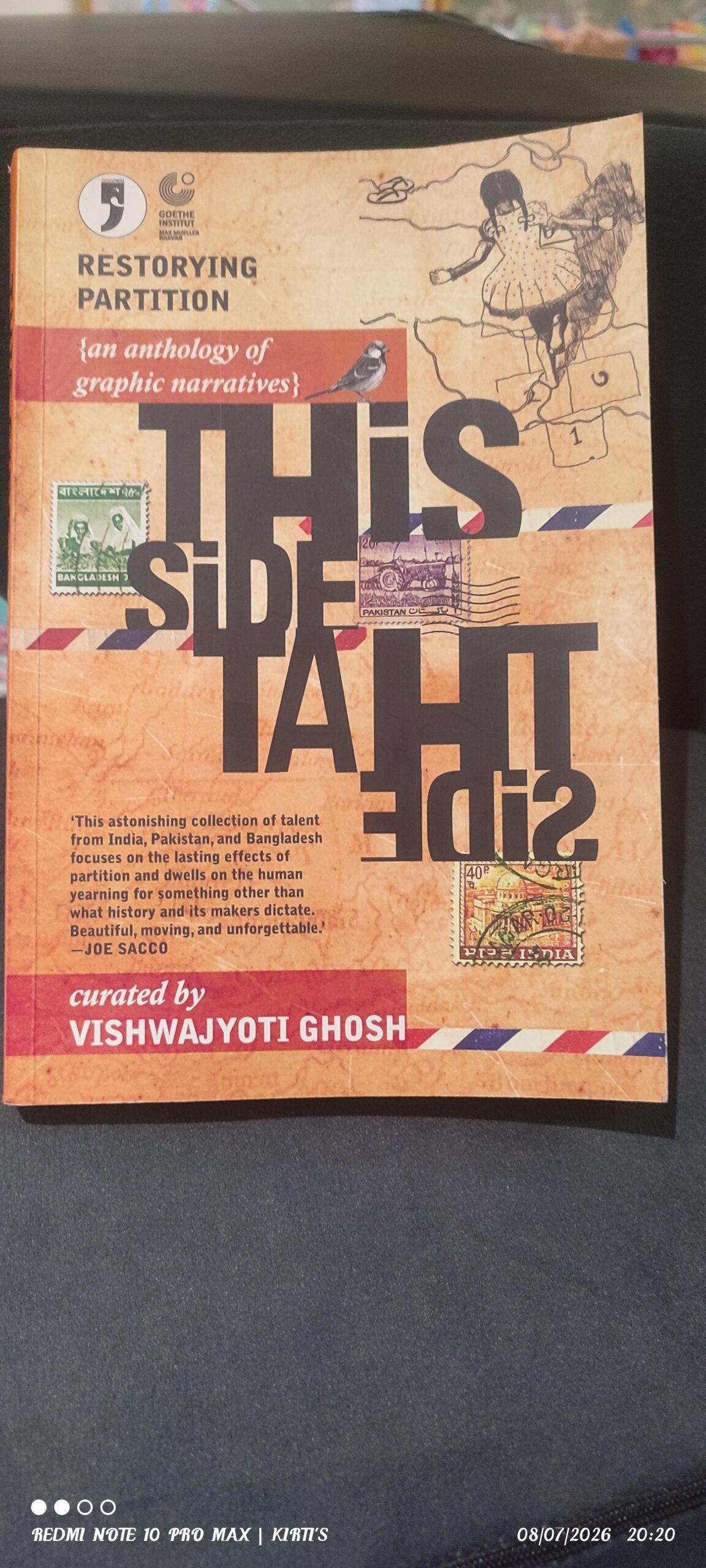
Title : This Side TAHT EDIS – Restorying Partition
Curator : Vishwajyoti Ghosh
Genre : Anthology of Graphic Narratives
Publisher : YodaPress
Partition, an incident that tugs the heart despite so many years. One might wonder what makes this book different from other partition stories. Well, this is not from one perspective. This book is an anthology where the writers hail from India, Pakistan and Bangladesh. So the partition after 1947 and the 1971 are presented here mostly as anecdotes from the people who have been there and gone through this cruel and forced migration.
The voices that are generally snubbed have been given prominence here. Also, the idea of making this a graphic narrative gives the whole narration more depth and makes it intense. The clever use of illustrations, the gutters and lines of a traditional graphic novel visually describe what we call the borders, separation and anxiety.
The collection begins with a famous fable of King Solomon. Two women present a child before the king claiming that the child is hers. The king then orders the child to be cut into three. How is this possible? How is this relevant to partition? Who are those women and who was the ‘WISE’ King? Read the story – An Old Fable to find out.
In the story Fault Lines a prison in no man’s land between India and Pakistan is shown. The date is midnight of 14-15 August 1947. The prisoners demand to be set free. One sees chaos outside his cell window and the other sees destruction. When finally their cell doors are unlocked, one makes a move outside and the other decides to stay back hoping for something better. The story ends with a quote from Rabindranath Tagore “Something terrific will come, no matter how dark the present.”
Borders – the title is quite relevant to the premise that we are talking about. The highlight of this story is its illustrations. A girl playing hopscotch over the lines that’s nothing but the international border or should I say, the Radcliff line. The story ends with the image of a man lying across the border lines. The lines humming a different national tune; you raise the universal flag of flaglessness hit you differently.
The Exit Plan written around the 1971 war, this story showcases the struggle of people who have been forced to move out. The plans, the pains and the fear of getting caught is brought to life through this story.
Every narrative in this collection is a personal experience or a tale that has been handed down through generations. We have tribes, the working class and even diplomats sharing their experiences of partition. What makes this stand out is the fact that the tales are from all the three countries that were split during the two partitions.
How can I not mention the first page and the last page of the book, the visa stampings. They seem legit and look like the ones that were actually stamped. Kudos to the contributing writers and the curator for coming up with a graphic narrative rather than a regular anthology. This narration of partition hits differently and hard too.
The book can be purchased from This Side TAHT EDIS
This is the kind of reviews that make you ache for the book. Can’t wait to meet you Kirti!
Aahhh Shinjini… 🙂 Let’s meet soon and discuss more on books